
Have you noticed that almost every software company now claims to offer “AI-powered” features? Some advertise AI chatbots, while others promote AI agents. At first glance, both seem capable of answering questions, automating tasks, and improving productivity. Many people including many students have confusion in between AI Agent vs AI Chatbot.
But they’re not the same. Choosing the wrong solution could mean paying for features you don’t need—or missing automation that could save hours every week.
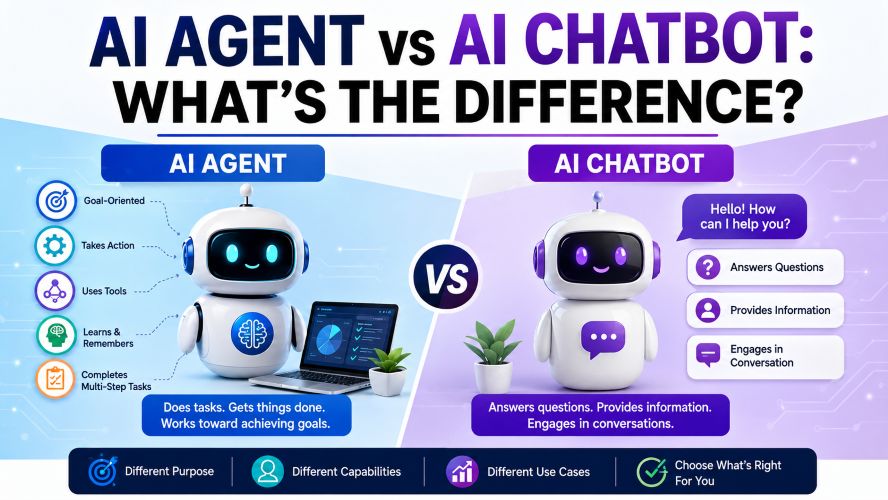
In this guide, you’ll learn exactly how AI agents differ from AI chatbots, when to use each one, and which option offers the best value for different users and businesses.
Whether you’re a blogger, entrepreneur, freelancer, developer, or business owner, this comparison will help you make an informed decision.
Quick Summary
| Feature | AI Chatbot | AI Agent |
|---|---|---|
| Primary Purpose | Conversations & answering questions | Completing goals and tasks |
| Decision Making | Limited | Advanced |
| Memory | Usually short-term | Long-term and contextual |
| Multi-Step Tasks | Basic | Excellent |
| Integrations | Limited | Extensive |
| Autonomy | Low | High |
| Best For | Customer support, FAQs | Business automation, productivity |
In simple words:
- AI chatbots are designed to chat.
- AI agents are designed to act.
What Is an AI Chatbot?
An AI chatbot is software designed to communicate with users through natural language.
Instead of clicking through menus or searching documentation, users simply ask a question and receive an answer in seconds.
Modern chatbots can understand context, answer frequently asked questions, recommend products, and even assist customers during purchases.
Common Chatbot Capabilities
- Answer customer questions
- Book appointments
- Recommend products
- Track orders
- Provide technical support
- Collect customer information
- Generate simple content
Most chatbots work reactively.
They wait for a user to ask something before responding.
Examples of AI Chatbot Use Cases
Customer Support
Visitors ask:
“Where is my order?”
The chatbot instantly checks order status.
E-commerce
Customers ask:
“Which laptop is best under $1,000?”
The chatbot recommends suitable products.
Education
Students ask:
“Explain cloud computing.”
The chatbot provides a simplified explanation.
Must Read : Best Claude Prompts for Content Writing (Blogs, SEO, YouTube Scripts)
Banking
Customers check:
- Account balance
- Loan information
- Credit card FAQs
without waiting for a support representative.
What Is an AI Agent?
An AI agent goes far beyond answering questions.
Instead of simply responding to prompts, it works toward achieving a goal.
It can plan, reason, gather information, make decisions based on predefined rules, and execute multiple actions automatically.
Think of it as a digital assistant that doesn’t just give advice—it actually gets work done.
AI Agent Example
Imagine saying:
“Research the top project management tools, compare pricing, summarize the best options, and create a spreadsheet.”
An AI chatbot might provide a list.
An AI agent could:
- Search trusted sources
- Compare features
- Organize the data
- Create a spreadsheet
- Save the file
- Notify you when finished
That ability to perform a sequence of actions is what makes AI agents different.
AI Agent vs AI Chatbot: Key Differences
| Feature | AI Chatbot | AI Agent |
|---|---|---|
| Interaction Style | Conversational | Goal-oriented |
| Autonomy | Low | High |
| Decision Making | Limited | Advanced |
| Workflow Automation | Basic | Complex |
| Multi-Step Reasoning | Limited | Strong |
| External Tool Usage | Sometimes | Frequently |
| Memory | Session-based | Persistent (depending on implementation) |
| Business Automation | Limited | Extensive |
| Learning from Context | Moderate | High |
| Best Use | Support and communication | Productivity and automation |
AI Agent vs AI Chatbot Explained with a Simple Example
Imagine you’re planning a vacation.
Using a Chatbot
You ask:
“What are the best places to visit in Japan?”
The chatbot suggests:
- Tokyo
- Kyoto
- Osaka
- Nara
You continue asking questions one by one.
Using an AI Agent
You say:
“Plan my 7-day Japan trip under $2,000.”
The AI agent could:
- Research destinations
- Compare hotels
- Find flights
- Build an itinerary
- Estimate expenses
- Create a travel checklist
- Organize everything into a document
Instead of just answering, it completes the project.
That’s the biggest difference.
When Should You Use an AI Chatbot?
A chatbot is often the right choice when communication is your main goal.
Best For
- Small businesses
- Online stores
- Personal websites
- Customer service
- Lead generation
- Appointment booking
- FAQ pages
Benefits
- Easy to deploy
- Affordable
- Fast responses
- Improves customer satisfaction
- Available 24/7
- Reduces support workload
When Should You Choose an AI Agent?
AI agents are ideal when your work involves multiple repetitive steps.
Instead of manually switching between apps, an AI agent can coordinate many tasks automatically.
Best For
- Business automation
- Project management
- Marketing workflows
- Research
- Data analysis
- Sales operations
- Software development
- Content planning
Must Read : Best Claude Prompts for Students (Notes, Exams, Revision)
Popular Business Tasks for AI Agents
- Email organization
- Market research
- Competitive analysis
- Workflow automation
- CRM updates
- Report generation
- Data collection
- Task scheduling
These capabilities can significantly reduce manual work while helping teams focus on higher-value activities.
Pros and Cons
AI Chatbots
Pros
- Easy to implement
- Lower cost
- Excellent for customer support
- Improves response times
- User-friendly
- Great for beginners
Cons
- Limited autonomy
- Cannot complete complex workflows
- Often requires user guidance
- Less effective for advanced automation
AI Agents
Pros
- Handles multi-step workflows
- Automates repetitive tasks
- Better decision-making
- Saves significant time
- Integrates with multiple business tools
- Scales well for growing teams
Cons
- Higher setup complexity
- May require workflow planning
- Usually costs more
- Can be unnecessary for simple support needs
Which One Is Better?
There isn’t a universal winner.
The right choice depends on what you’re trying to accomplish.
Choose an AI Chatbot if you need:
- Customer support
- Website assistance
- Product recommendations
- FAQ automation
- Lead capture
- Appointment scheduling
Choose an AI Agent if you need:
- Workflow automation
- Research assistance
- Business process optimization
- Multi-step task execution
- Productivity improvements
- Cross-platform automation
For many organizations, the most effective approach is to use both: a chatbot for customer interactions and an AI agent for internal operations.
How to Choose Between an AI Agent and an AI Chatbot
With so many platforms available, it’s easy to assume the most advanced option is always the best. In reality, the right choice depends on your goals, budget, and workflow.
Ask yourself these questions before investing in any platform:
- Do you need to answer customer questions or automate business processes?
- Will the software be used by customers, employees, or both?
- Does it need to connect with your existing tools?
- How much customization do you need?
- What is your monthly budget?
If your primary goal is improving customer communication, a chatbot is often the better fit.
If you’re trying to reduce repetitive work and automate complex tasks, an AI agent is usually worth the investment.
AI Agent vs AI Chatbot Decision Matrix
| Your Goal | Best Choice |
|---|---|
| Answer FAQs | AI Chatbot |
| Customer Support | AI Chatbot |
| Product Recommendations | AI Chatbot |
| Appointment Booking | AI Chatbot |
| Workflow Automation | AI Agent |
| Research & Analysis | AI Agent |
| Data Processing | AI Agent |
| Multi-Step Task Execution | AI Agent |
| Team Productivity | AI Agent |
| Business Operations | AI Agent |
Features to Look for Before Choosing a Platform
Not all tools offer the same capabilities. Focus on features that match your needs rather than paying for extras you may never use.
Ease of Setup
A beginner-friendly platform should offer:
- Simple onboarding
- Clear documentation
- Pre-built templates
- Minimal coding requirements
If your team is small, this can save hours during implementation.
Integration Support
The best platforms work well with the tools you already use.
Look for integrations with:
- Email platforms
- CRM software
- Project management apps
- Cloud storage
- Team collaboration tools
- Calendar applications
The more seamlessly your tools work together, the greater the productivity gains.
Customization
Every business has unique workflows.
Choose a platform that lets you:
- Customize responses
- Build custom workflows
- Add business rules
- Configure permissions
- Personalize user experiences
Security and Privacy
If you’ll be handling customer or business data, security should be a priority.
Consider whether the platform offers:
- Data encryption
- User access controls
- Audit logs
- Compliance with relevant privacy standards
- Transparent data handling policies
Pricing
Don’t judge a platform by its entry-level plan alone.
Compare:
- Monthly subscription cost
- Usage limits
- Number of users included
- Automation limits
- Premium integrations
- Scalability as your needs grow
A slightly higher-priced option may deliver better long-term value if it saves significant time.
Common Mistakes to Avoid
Many first-time buyers choose software based on marketing claims rather than actual requirements.
Here are some common pitfalls to avoid:
Buying More Than You Need
If your only requirement is answering customer questions, an advanced AI agent platform may add unnecessary complexity and cost.
Ignoring Integrations
Even the best tool becomes less useful if it can’t connect with the software your business already relies on.
Overlooking Scalability
Your needs may grow over time.
Choose a platform that can handle increased users, data, or automation without requiring a complete migration.
Focusing Only on Price
The cheapest option isn’t always the most cost-effective.
Consider the value of time saved, improved customer experience, and operational efficiency.
Must Read : Claude vs ChatGPT Prompts: What Works Better?
Real-World Scenarios
Scenario 1: Small Online Store
Challenge: Customers frequently ask about shipping, returns, and product availability.
Recommended Solution: AI Chatbot
Why?
- Instant responses
- Reduced support workload
- Better shopping experience
Scenario 2: Marketing Agency
Challenge: The team spends hours researching competitors, organizing reports, and updating project information.
Recommended Solution: AI Agent
Why?
- Automates repetitive research
- Organizes information efficiently
- Improves team productivity
Scenario 3: SaaS Company
Challenge: Support tickets continue to increase while internal teams also need workflow automation.
Recommended Solution: Both
A chatbot handles customer conversations while an AI agent supports internal operations, creating a balanced and scalable solution.
Pros and Cons at a Glance
| AI Chatbot | AI Agent |
|---|---|
| Lower cost | More powerful automation |
| Easy setup | Handles complex workflows |
| Great for customer support | Better for business operations |
| Limited autonomy | Higher autonomy |
| Beginner-friendly | More advanced configuration |
| Fast deployment | Greater long-term productivity |
Frequently Asked Questions
1. What is the biggest difference between an AI agent and an AI chatbot?
An AI chatbot primarily focuses on conversations and answering questions. An AI agent is designed to achieve goals by planning and completing tasks, often involving multiple steps and integrations.
2. Can an AI chatbot become an AI agent?
Some modern platforms combine conversational interfaces with automation features. However, true AI agents generally have greater autonomy, planning capabilities, and workflow management than traditional chatbots.
3. Which is better for small businesses?
For businesses that mainly need customer support or lead generation, a chatbot is usually sufficient. If repetitive internal processes consume valuable time, an AI agent may offer a better return on investment.
4. Are AI agents more expensive?
In many cases, yes. Because they provide more advanced automation and integration capabilities, AI agent platforms often have higher pricing tiers than chatbot solutions.
5. Can I use both together?
Absolutely. Many organizations use a chatbot to assist customers and an AI agent to streamline internal operations. This combination can improve both customer experience and team efficiency.
6. Which option is easier to set up?
AI chatbots are generally quicker to deploy and require less configuration. AI agents may involve more planning, especially when connecting multiple tools or creating automated workflows.
7. Are AI agents replacing AI chatbots?
Not necessarily. The two technologies serve different purposes and often complement each other rather than compete directly.
Final Verdict
When comparing AI agents and AI chatbots, the key difference comes down to conversation versus action.
If your goal is to answer questions, support customers, or provide instant assistance, an AI chatbot is a practical and cost-effective solution.
If your goal is to automate workflows, reduce manual effort, and complete multi-step tasks across different tools, an AI agent is the better choice.
Many growing businesses find the greatest value in combining both technologies—using chatbots to improve customer interactions while relying on AI agents to automate behind-the-scenes operations.
Instead of choosing the platform with the longest feature list, focus on the one that solves your most important challenges today and can grow with your needs tomorrow.