
Every writer has faced it. You sit down with a great idea, open a blank page, and suddenly nothing comes to mind. Sometimes it’s writer’s block. Other times it’s knowing what to write but struggling with how to structure it. Best Claude Prompts for Content Writing will help you solve this problem.
Whether you’re publishing blog posts, optimizing content for search engines, or writing engaging YouTube scripts, the quality of your prompts plays a major role in the quality of your output.
Instead of spending hours brainstorming outlines, rewriting introductions, or organizing ideas, you can use carefully designed prompts to speed up the entire writing process while maintaining clarity and consistency.
In this guide, you’ll discover practical Claude prompts for bloggers, SEO professionals, YouTube creators, marketers, and freelance writers. Every prompt is designed to save time while helping you produce well-structured, reader-friendly content.
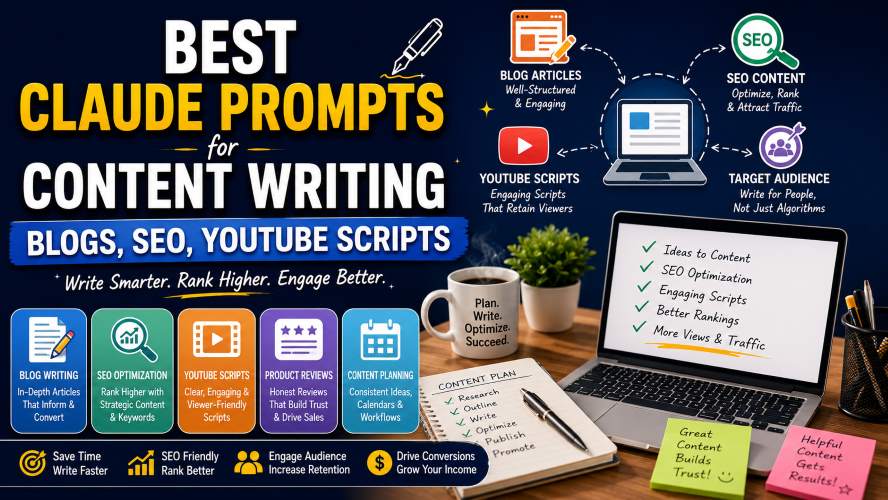
Quick Summary
| Content Type | Recommended Prompt |
|---|---|
| Blog Posts | SEO article prompt |
| YouTube Videos | Script prompt |
| SEO | Keyword optimization prompt |
| Product Reviews | Review template prompt |
| Tutorials | Step-by-step guide prompt |
| Email Marketing | Email sequence prompt |
| Social Media | Caption prompt |
| Content Planning | Editorial calendar prompt |
Bottom Line: The most effective prompts clearly define the audience, purpose, tone, structure, and desired outcome. A few extra details in your prompt can significantly improve the final result.
Why Prompt Quality Matters
Many writers use prompts like:
Write a blog about WordPress.
While this works, the response is usually broad and lacks direction.
Now compare it with:
Write a beginner-friendly 2,000-word WordPress guide. Include SEO headings, practical examples, FAQs, comparison tables, common mistakes, and a conclusion.
The second prompt provides:
- A clear objective
- Target audience
- Word count
- Structure
- Formatting expectations
As a result, the writing is more focused and requires fewer revisions.
Must Read : How to Start Vibe Coding in 2026: Complete Beginner Guide
What Makes a Great Writing Prompt?
Regardless of your niche, effective prompts usually contain five key elements.
1. Define the Goal
Instead of:
Write about SEO.
Try:
Write an educational guide explaining on-page SEO for beginners.
Specific goals produce more relevant results.
2. Identify the Audience
Who are you writing for?
Examples include:
- Beginners
- Bloggers
- Small businesses
- Students
- Developers
- Digital marketers
- Content creators
Knowing the audience influences tone, vocabulary, and complexity.
3. Choose the Format
Specify the desired output.
Examples:
- Blog post
- Tutorial
- Product review
- Buying guide
- Checklist
- Comparison article
- FAQ
- YouTube script
Formatting instructions reduce editing time later.
4. Mention the Tone
Examples include:
- Conversational
- Professional
- Friendly
- Educational
- Persuasive
- Informative
A consistent tone improves readability and user engagement.
5. Add Constraints
Helpful constraints include:
- Word count
- Reading level
- Markdown formatting
- SEO requirements
- Bullet points
- Tables
- FAQs
The more specific the instructions, the better the structure.
Best Claude Prompts for Blog Writing
Blog writing involves much more than simply producing paragraphs.
A well-written article should answer user questions, maintain reader interest, and provide clear value.
Prompt 1: Complete SEO Blog Post
Write a comprehensive blog post on [topic] for beginners. Use H2 and H3 headings, include examples, FAQs, comparison tables, key takeaways, and a conclusion. Maintain a conversational tone and optimize for readability.
Best For
- Affiliate blogs
- Tech blogs
- Educational websites
- Business blogs
Prompt 2: Blog Outline
Create a detailed outline for a long-form article. Include an engaging introduction, logical headings, FAQs, and a strong conclusion.
A strong outline makes writing much faster.
Prompt 3: Rewrite for Better Readability
Rewrite this article using shorter paragraphs, simpler language, and smoother transitions while preserving the original meaning.
This is useful when updating older blog posts.
Prompt 4: Improve Existing Content
Review this article and suggest improvements for readability, organization, clarity, and engagement. Highlight sections that need expansion.
Refreshing older content can improve user experience and search performance.
Best Claude Prompts for SEO Writing
Good SEO writing balances search visibility with reader satisfaction.
These prompts help organize content without sacrificing readability.
Must Read : Claude vs ChatGPT (2026): Which AI Is Better for Coding, Writing, and Research?
Prompt 5: SEO Article Structure
Create an SEO-friendly outline for the keyword “[primary keyword]”. Include related headings, common user questions, comparison opportunities, and FAQ ideas.
Perfect for planning articles before writing.
Prompt 6: Keyword Placement
Naturally incorporate the following primary and secondary keywords throughout this article while maintaining readability and avoiding keyword stuffing.
This keeps content user-friendly while improving topical relevance.
Prompt 7: Meta Title and Description
Write five SEO-friendly titles under 60 characters and five compelling meta descriptions between 150 and 160 characters.
Testing multiple versions often improves click-through rates.
Prompt 8: Featured Snippet Optimization
Rewrite this section to answer the question directly within the first paragraph, followed by supporting details.
Featured snippets often favor concise answers followed by additional context.
Best Claude Prompts for YouTube Scripts
Video content requires a different writing style than blog posts.
The goal is to capture attention quickly and maintain viewer interest.
Prompt 9: Educational Script
Write a 10-minute YouTube script explaining [topic]. Include a strong hook, logical sections, practical examples, transition sentences, and a memorable conclusion.
Prompt 10: Product Review Script
Create an unbiased product review script covering features, benefits, drawbacks, ideal users, and a final recommendation.
Balanced reviews build credibility.
Prompt 11: Tutorial Script
Write a step-by-step tutorial script that explains the process clearly while keeping viewers engaged from beginning to end.
Ideal for software walkthroughs and educational channels.
Quick Prompt Library
| Goal | Prompt |
|---|---|
| Blog Article | Complete SEO article |
| Outline | Blog outline |
| SEO | Keyword optimization |
| YouTube | Video script |
| Review | Product review |
| Tutorial | Step-by-step guide |
| Updating Content | Rewrite existing article |
| Metadata | SEO title and description |
Why These Prompts Work
The biggest difference between average prompts and high-performing prompts is clarity.
Each example above clearly defines:
- The objective
- Target audience
- Structure
- Tone
- Formatting
- Desired outcome
That reduces guesswork and leads to more organized, reader-focused content.
Advanced Prompts for SEO Content
Publishing consistently is important, but publishing search-focused content is what drives long-term traffic.
These prompts are designed to improve structure, topical coverage, and user experience.
Prompt 12: Content Brief Generator
Create a detailed content brief for the keyword “[keyword].” Include search intent, target audience, article outline, important questions to answer, supporting topics, and suggested word count.
Best For
- Content planning
- Freelancers
- SEO agencies
- Affiliate bloggers
A well-structured brief keeps the writing process organized from the beginning.
Prompt 13: Search Intent Analyzer
Analyze the search intent behind the keyword “[keyword]” and explain whether users are looking for informational, commercial, comparison, or transactional content.
Matching search intent improves the chances of satisfying readers.
Prompt 14: FAQ Generator
Generate ten frequently asked questions related to this topic. Provide concise, accurate answers suitable for a blog article.
FAQ sections improve user experience and can target additional long-tail keywords.
Prompt 15: Content Gap Finder
Review this article and identify missing topics, unanswered questions, and opportunities to make the content more comprehensive.
Excellent for updating older articles.
Prompts for Affiliate Blog Writing
Affiliate content should educate readers before recommending products or services.
These prompts encourage a balanced approach that builds trust.
Prompt 16: Product Review
Write an unbiased product review covering key features, benefits, limitations, ideal users, and practical use cases. End with a balanced recommendation.
A transparent review is more valuable than exaggerated praise.
Prompt 17: Comparison Article
Compare Product A and Product B using a detailed table. Explain similarities, differences, strengths, weaknesses, pricing considerations, and who each option is best suited for.
Comparison articles often perform well because they help readers make informed decisions.
Prompt 18: Buying Guide
Create a beginner-friendly buying guide explaining what to look for before purchasing this type of product. Include important features, common mistakes, and frequently asked questions.
Buying guides attract readers who are actively researching a purchase.
Must Read : 25 Best Claude Prompts for Coding, Research, and Content Creation
Prompt 19: Pros and Cons
List the major advantages and disadvantages of this product or service. Keep the evaluation balanced and explain each point clearly.
Honest evaluations increase credibility.
Prompts for YouTube Content
A successful video script keeps viewers engaged from the first few seconds to the final call-to-action.
Prompt 20: Strong Video Hook
Write five engaging opening hooks that immediately capture attention without using clickbait.
The first few seconds often determine whether viewers continue watching.
Prompt 21: Storytelling Script
Rewrite this informational topic using storytelling techniques while maintaining educational value.
Stories help explain complex ideas in a memorable way.
Prompt 22: Educational Video Series
Break this large topic into a five-part educational video series. Suggest titles, learning objectives, and transitions between episodes.
Great for building a content series around a single topic.
Prompt 23: Call-to-Action Ideas
Suggest five natural calls-to-action that encourage viewers to continue learning without sounding overly promotional.
Soft CTAs typically feel more authentic.
Prompts for Content Refreshing
Updating existing content can be just as valuable as publishing something new.
Prompt 24: Refresh Old Articles
Review this article and recommend updates based on readability, organization, missing information, and outdated sections.
A refreshed article often provides a better experience for returning readers.
Prompt 25: Improve Headings
Rewrite these headings to make them more descriptive, engaging, and easier to scan.
Clear headings improve navigation and readability.
Prompt 26: Improve Introduction
Rewrite the introduction using a stronger hook, clear problem statement, and curiosity-driven transition into the article.
The introduction determines whether readers continue scrolling.
Prompts for Content Planning
Consistency becomes much easier with a publishing plan.
Prompt 27: Monthly Editorial Calendar
Create a 30-day editorial calendar around the topic “[niche].” Include blog posts, supporting articles, and seasonal content ideas.
Planning reduces last-minute content decisions.
Prompt 28: Content Cluster Ideas
Suggest pillar articles and supporting topics for building topical authority around “[topic].”
A strong content structure improves navigation and encourages internal linking.
Prompt 29: Repurpose Existing Content
Turn this blog article into a YouTube script, newsletter, social media posts, and an email sequence while preserving the core message.
Repurposing helps maximize the value of every article.
Real-World Content Workflows
Blogger
Needs long-form educational articles optimized for readers.
Recommended Prompts
- Content brief
- Blog outline
- SEO article
- FAQ generator
- Content refresh
Affiliate Marketer
Focuses on helping readers compare products before making a decision.
Recommended Prompts
- Buying guide
- Product review
- Comparison table
- Pros and cons
- Call-to-action suggestions
YouTube Creator
Needs engaging scripts that retain viewers.
Recommended Prompts
- Video hook
- Educational script
- Storytelling prompt
- Episode planner
Freelance Writer
Works across multiple industries and writing styles.
Recommended Prompts
- Content brief
- Search intent analyzer
- Editorial calendar
- Content gap finder
Benefits of Structured Writing Prompts
Using structured prompts can help you:
- Create detailed outlines faster.
- Maintain a consistent writing style.
- Organize ideas before drafting.
- Improve article readability.
- Build stronger educational content.
- Reduce editing time.
- Develop a repeatable writing workflow.
The real advantage isn’t writing more—it’s writing with greater clarity and consistency.
Pros and Cons
| Pros | Cons |
|---|---|
| Speeds up planning | Requires clear instructions |
| Encourages organized structure | May need manual refinement |
| Improves consistency | Should always be reviewed before publishing |
| Useful for multiple content formats | Doesn’t replace subject expertise |
| Helps overcome writer’s block | Best results come with iterative improvements |
Traditional Writing Workflow vs Structured Prompts
| Feature | Traditional Workflow | Structured Prompts |
|---|---|---|
| Brainstorming | Manual | Guided |
| Outlining | Time-consuming | Faster |
| SEO Planning | Separate process | Integrated |
| Article Updates | Manual review | Easier to organize |
| Content Repurposing | Often overlooked | Planned from the start |
| Publishing Consistency | Variable | More predictable |
Things to Consider Before Upgrading
If you’re thinking about a premium plan, ask yourself:
- How many articles do you publish each month?
- Do you write in multiple formats (blogs, videos, newsletters)?
- Do you regularly update existing content?
- Do you need support for longer documents or projects?
- Does the available plan fit your budget and workflow?
For occasional writing, basic features may be enough. If you produce content regularly, reviewing the latest plans and capabilities can help you choose the option that best matches your needs.
Frequently Asked Questions (FAQs)
SEO Note: The following FAQs are optimized for Google’s People Also Ask (PAA) section and featured snippets by providing concise, direct answers.
1. What are Claude prompts for content writing?
Claude prompts for content writing are structured instructions that help organize writing tasks such as blog posts, SEO articles, YouTube scripts, product reviews, email campaigns, and content outlines. Clear prompts typically produce more focused and better-structured results.
2. How do I write better prompts for blog articles?
A strong writing prompt should include:
- The article topic
- Target audience
- Search intent
- Preferred tone
- Desired word count
- Formatting requirements
- Sections to include
- Any SEO considerations
The more context you provide, the more relevant the response becomes.
3. Can Claude help with SEO writing?
Yes.
It can assist with planning article outlines, generating title ideas, writing meta descriptions, creating FAQ sections, organizing headings, and identifying supporting topics. These tasks help streamline the writing process while keeping content structured and reader-focused.
4. What is the best prompt for writing YouTube scripts?
A useful prompt might be:
Write a 10-minute educational YouTube script with a strong opening hook, logical sections, engaging transitions, practical examples, and a memorable conclusion.
Adding details about your audience and desired tone can make the script even more effective.
5. Can Claude help overcome writer’s block?
Many writers use prompts to generate ideas, create outlines, brainstorm headlines, or rewrite introductions. Breaking large writing tasks into smaller steps often makes it easier to get started and maintain momentum.
6. Are structured prompts suitable for beginners?
Absolutely.
Beginners can use simple prompts to create outlines or summaries, while experienced writers can add detailed instructions for SEO, formatting, and audience targeting. As your skills grow, your prompts can become more specific and tailored to your workflow.
7. What types of content can I create?
Structured prompts are useful for many formats, including:
- Blog posts
- Buying guides
- Product reviews
- Comparison articles
- Tutorials
- Landing pages
- Email newsletters
- YouTube scripts
- Social media captions
- Frequently asked questions
8. Can prompts replace writing skills?
No.
Prompts are tools that help organize ideas and speed up the writing process. Strong research, editing, subject knowledge, and understanding your audience remain essential for creating valuable content.
Best Practices for Better Writing Prompts
Regardless of your niche, these habits can improve your results.
Start with a Clear Goal
Instead of saying:
Write about blogging.
Try:
Write a beginner-friendly guide explaining how to start a technology blog with practical examples and common mistakes to avoid.
Specific requests reduce ambiguity.
Define Your Audience
Every piece of content should target a specific reader.
Examples include:
- Beginners
- Small business owners
- Students
- Developers
- Bloggers
- Content marketers
Knowing your audience influences tone, vocabulary, and examples.
Request a Structure
Ask for:
- H2 and H3 headings
- Bullet points
- Comparison tables
- FAQs
- Key takeaways
- Actionable tips
Structured content is easier to read and navigate.
Improve Through Iteration
Rather than expecting a perfect first draft, refine your prompts by requesting:
- More examples
- Better transitions
- Simpler language
- Additional FAQs
- Shorter paragraphs
- Expanded sections
Small improvements often lead to stronger final content.
Key Takeaways
If you only remember a few ideas from this guide, make them these:
- A well-written prompt starts with a clear objective.
- Detailed instructions produce more useful and organized content.
- Matching the prompt to the content type improves efficiency.
- Planning before writing reduces editing later.
- Different formats—blogs, reviews, tutorials, and scripts—benefit from different prompt styles.
- Consistency in your workflow is often more valuable than speed.
Who Should Use These Prompts?
These prompts are especially useful for:
Bloggers
Create comprehensive articles with clear structure and improved readability.
Affiliate Marketers
Develop balanced buying guides, product comparisons, and informative reviews that help readers make informed decisions.
YouTube Creators
Write engaging scripts with strong hooks, natural transitions, and clear conclusions.
Freelance Writers
Speed up planning, outlining, editing, and content organization across multiple client projects.
Business Owners
Produce educational website content, newsletters, FAQs, and product pages that answer customer questions effectively.
Final Verdict
Creating great content isn’t just about writing more—it’s about writing with purpose.
Well-crafted prompts help organize ideas, streamline research, improve structure, and reduce the time spent staring at a blank page. Whether you’re publishing blog posts, planning SEO articles, creating YouTube scripts, or writing detailed buying guides, a thoughtful prompt can make the process more efficient and consistent.
The most effective approach is to build a personal prompt library. Over time, you’ll discover which prompts work best for different content types and audiences, allowing you to produce higher-quality content with less effort.
If you publish content regularly, exploring additional features and available plans may be worthwhile. Compare your options carefully and choose the one that best supports your workflow.
Conclusion
Every successful article, video, or guide starts with a clear idea—and a clear prompt.
Instead of treating prompts as one-time instructions, think of them as reusable templates that improve your workflow over time. The more you refine them, the more consistent your content becomes.
Whether you’re building a blog, growing a YouTube channel, or managing content for clients, investing time in creating better prompts can improve planning, reduce repetitive work, and help you stay focused on delivering value to your audience.
Experiment with different prompt styles, save the ones that work best, and continue refining your process. Small improvements in your prompts can lead to noticeable improvements in the quality, consistency, and effectiveness of your content.
This is a goldmine of prompts. I can now generate lots of content using this
Yes certainly you can now create lots of content