
Technology has never stood still. Just a few years ago, cloud computing, DevOps, and cybersecurity dominated hiring conversations. Today, another wave of innovation is transforming nearly every technical role, from software development and data analysis to IT support and digital marketing. These AI trends changing tech jobs will help you in this year for sure.
The biggest question isn’t whether these changes are happening. It’s whether your skills will evolve fast enough to keep up.
The good news is that this shift is creating as many opportunities as challenges. While some routine tasks are becoming automated, demand is growing for professionals who know how to work alongside intelligent tools, solve complex problems, and make better business decisions.
In this guide, you’ll discover the 10 biggest AI trends changing tech jobs, what they mean for your career, and practical ways to stay competitive over the next three years.
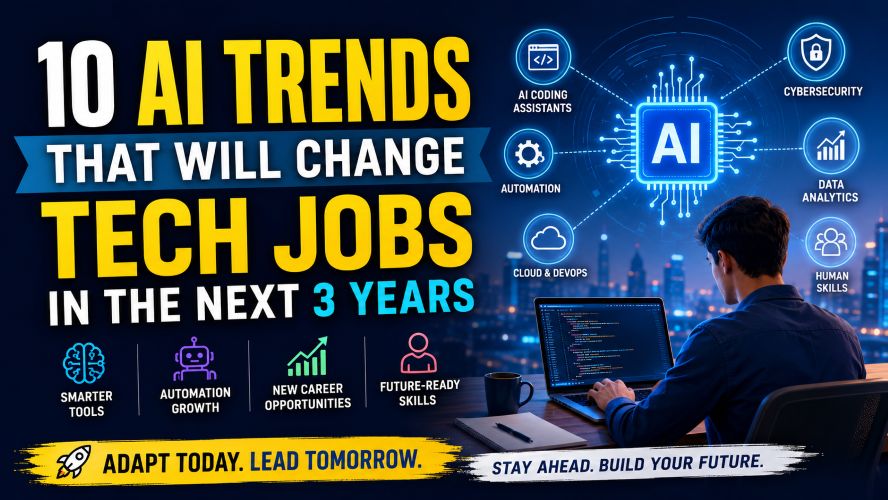
If you’re short on time, here’s what you need to know.
| Trend | Impact on Jobs |
|---|---|
| AI coding assistants | Faster software development |
| Intelligent automation | Fewer repetitive tasks |
| AI-powered cybersecurity | Higher demand for security experts |
| Low-code development | More citizen developers |
| AI data analytics | Faster business decisions |
Bottom line: Professionals who combine technical expertise with problem-solving, communication, and business understanding will have the strongest career prospects.
Must Read : Best Claude Prompts for Content Writing (Blogs, SEO, YouTube Scripts)
Why These AI Trends Matter
Technology companies are under constant pressure to deliver products faster, reduce costs, and improve customer experiences.
Instead of replacing entire professions, modern AI tools are increasingly handling repetitive work while leaving strategic thinking, creativity, collaboration, and decision-making to people.
This means many tech jobs won’t disappear—but they will change.
Professionals who adapt early are more likely to qualify for higher-paying positions and leadership opportunities.
Trend #1: AI Coding Assistants Become Every Developer’s Partner
What Is Happening?
Writing software is becoming faster thanks to coding assistants that can generate code suggestions, explain unfamiliar syntax, identify bugs, and recommend improvements.
These tools don’t replace developers. Instead, they reduce time spent on repetitive coding tasks, allowing teams to focus on architecture, performance, and innovation.
Why It Matters
Developers now spend less time writing boilerplate code and more time solving real business problems.
Companies are increasingly looking for engineers who can:
- Review generated code
- Improve code quality
- Design scalable systems
- Build secure applications
- Debug complex issues
Skills Worth Learning
- Software architecture
- Clean code principles
- API development
- Cloud-native applications
- Testing and debugging
Career Impact
| Before | After |
|---|---|
| Manual coding | Assisted development |
| Long debugging sessions | Faster issue detection |
| Writing repetitive functions | Designing better systems |
Practical Tip
Instead of memorizing every programming syntax, focus on understanding algorithms, software design patterns, and problem-solving techniques.
These skills remain valuable regardless of how development tools evolve.
Want to build stronger coding skills?
Trend #2: Intelligent Automation Is Replacing Repetitive IT Tasks
More Automation, Less Manual Work
Many IT departments still spend countless hours resetting passwords, monitoring servers, generating reports, and handling repetitive support tickets.
Automation platforms now complete many of these tasks within seconds.
This allows IT professionals to focus on projects that create real business value.
Tasks Most Likely to Be Automated
- Password resets
- System monitoring
- Backup scheduling
- Basic troubleshooting
- Ticket categorization
- Routine software deployment
Skills Growing in Demand
- Workflow automation
- Process optimization
- Cloud administration
- Infrastructure management
- Scripting
Real-World Example
Imagine an IT administrator responsible for managing hundreds of employee devices.
Instead of updating each device manually, automated workflows deploy updates, monitor failures, and notify administrators only when human intervention is needed.
That shift saves hours every week.
Must Read : Claude Prompts That Actually Work in 2026 (Tested Results)
Benefits for Businesses
- Lower operational costs
- Faster response times
- Improved reliability
- Reduced human error
- Better employee productivity
Things to Remember
Automation doesn’t eliminate technical teams.
It changes what they spend their time doing.
Professionals who understand automation tools often become even more valuable because they manage the systems that everyone else relies on.
Trend #3: AI-Powered Cybersecurity Is Becoming Essential
Cyber threats continue to grow in both volume and sophistication.
Traditional security methods often struggle to keep up with new attack techniques.
That’s why organizations increasingly rely on intelligent security platforms that can detect unusual behavior, identify threats earlier, and respond more quickly.
Why Security Professionals Are Still Critical
Even advanced security software cannot:
- Understand business risks
- Make legal decisions
- Investigate complex attacks
- Develop security policies
- Train employees
- Respond to major incidents strategically
Human expertise remains essential.
Most Valuable Skills
- Network security
- Cloud security
- Identity management
- Threat intelligence
- Incident response
- Security auditing
Industries Hiring
- Healthcare
- Finance
- Government
- Retail
- SaaS companies
- Manufacturing
Career Outlook
Cybersecurity continues to offer strong long-term opportunities because every industry depends on protecting sensitive information.
Professionals who combine security knowledge with automation skills are becoming particularly valuable.
Trend #4: Low-Code and No-Code Platforms Expand Tech Careers
Not every business application requires thousands of lines of custom code.
Low-code and no-code platforms allow teams to build internal tools, dashboards, and workflows much faster.
What This Means
Business analysts, project managers, and operations teams can now create simple applications without being full-time developers.
Professional developers, meanwhile, spend more time building advanced systems rather than basic business tools.
Advantages
- Faster project delivery
- Lower development costs
- Easier collaboration
- Rapid prototyping
- Increased productivity
Must Read : Best Claude Prompts for Students (Notes, Exams, Revision)
Who Benefits Most?
- Business analysts
- Product managers
- Startup founders
- IT administrators
- Small business owners
Skills to Learn
- Process mapping
- Database basics
- Workflow design
- API integration
- Business analysis
Important Limitation
Low-code tools work best for straightforward business applications.
Large-scale enterprise systems still require experienced software engineers.
Trend #5: Data Analytics Is Becoming More Accessible
Companies generate enormous amounts of information every day.
The challenge isn’t collecting data.
It’s understanding what that data actually means.
Modern analytics platforms help professionals explore trends, build dashboards, and identify patterns much faster than traditional methods.
Must Read : Claude vs ChatGPT Prompts: What Works Better?
Why This Matters
Every department—from marketing and finance to engineering and HR—depends on data to make smarter decisions.
That creates opportunities for professionals who know how to:
- Interpret reports
- Ask better business questions
- Build meaningful dashboards
- Communicate insights clearly
Technical Skills That Stand Out
- SQL
- Spreadsheet analysis
- Data visualization
- Dashboard creation
- Business intelligence tools
- Basic statistics
Soft Skills Matter Too
Employers increasingly value people who can explain technical findings in plain language.
Being able to turn numbers into actionable recommendations is often more valuable than simply creating charts.
Quick Comparison: Traditional vs Modern Data Analytics
| Traditional Analytics | Modern Analytics |
|---|---|
| Manual reporting | Automated dashboards |
| Static spreadsheets | Interactive visualizations |
| Hours of analysis | Faster insight generation |
| Technical users only | Wider business adoption |
Key Takeaways So Far
The first five trends reveal a clear pattern:
- Routine technical work is becoming more automated.
- Strategic thinking is becoming more valuable.
- Collaboration between technical and non-technical teams is increasing.
- Continuous learning is now a career advantage, not just a bonus.
- Professionals who combine technical expertise with communication and business knowledge will be better positioned for future opportunities.
Trend #6: AI Is Transforming Cloud Computing and DevOps
Cloud platforms are becoming smarter, helping teams manage infrastructure more efficiently than ever before.
Tasks like scaling servers, monitoring system performance, identifying unusual resource usage, and predicting outages are increasingly supported by intelligent automation.
Instead of spending hours reacting to issues, DevOps teams can focus on improving reliability and delivering new features faster.
Why This Trend Matters
As more businesses move their applications to the cloud, the need for professionals who understand cloud architecture continues to grow.
Rather than replacing cloud engineers, automation helps them work more efficiently.
Skills Worth Building
- Cloud architecture fundamentals
- Infrastructure as Code (IaC)
- CI/CD pipelines
- Container technologies
- Kubernetes
- Cloud cost optimization
- Monitoring and observability
Who Benefits?
- Cloud Engineers
- DevOps Engineers
- Site Reliability Engineers (SREs)
- Infrastructure Architects
Trend #7: Personalized Learning Is Reshaping Tech Careers
Technology changes quickly, making continuous learning essential.
Modern learning platforms now recommend personalized learning paths based on your experience, career goals, and existing skills.
Instead of following generic courses, professionals can focus on the topics most relevant to their roles.
Benefits
- Faster skill development
- More focused learning
- Better certification preparation
- Easier career transitions
Example
A web developer interested in cybersecurity can receive a customized roadmap covering networking, Linux, penetration testing, and cloud security without spending months figuring out where to begin.
Trend #8: Human Skills Are Becoming More Valuable
One surprising trend is that technical expertise alone is no longer enough.
As automation handles repetitive work, employers increasingly look for professionals who can solve business problems, collaborate with teams, and communicate clearly.
The Skills Employers Value Most
- Critical thinking
- Communication
- Leadership
- Creativity
- Problem-solving
- Adaptability
- Decision-making
These skills complement technical knowledge and are difficult to automate.
Why It Matters
The professionals who advance into senior positions are often those who can explain complex ideas in simple terms and work effectively across different departments.
Trend #9: Responsible AI and Data Governance Are Creating New Roles
As businesses rely more on intelligent technologies, responsible use of data has become a priority.
Organizations now need professionals who understand privacy, compliance, governance, and risk management.
Emerging Career Opportunities
- AI Governance Specialist
- Data Privacy Analyst
- Compliance Consultant
- Risk Manager
- Responsible Technology Advisor
Skills to Learn
- Data privacy regulations
- Information governance
- Risk assessment
- Ethics in technology
- Compliance frameworks
These roles are expected to become increasingly important as regulations continue to evolve.
Trend #10: Cross-Functional Tech Professionals Will Stand Out
The future belongs to professionals who understand more than one discipline.
Rather than specializing in a single technical area, many employers now prefer candidates who combine multiple complementary skills.
Examples include:
- Software Development + Cloud
- Cybersecurity + Networking
- Data Analytics + Business Intelligence
- DevOps + Automation
- UX Design + Front-End Development
Why This Matters
Cross-functional professionals adapt more easily to changing business needs and often qualify for leadership opportunities sooner.
Instead of becoming an expert in everything, aim to build a “T-shaped” skill set:
- Deep expertise in one area
- Working knowledge of several related fields
Comparison Table: Traditional Tech Jobs vs Future Tech Roles
| Traditional Role | Future-Focused Role | Key Skills Needed |
|---|---|---|
| Software Developer | Software Engineer + Automation | System Design, APIs, Architecture |
| IT Support | IT Automation Specialist | Scripting, Automation, Cloud |
| Data Analyst | Business Intelligence Professional | SQL, Dashboards, Storytelling |
| System Administrator | Cloud Engineer | Cloud Platforms, IaC, Security |
| QA Tester | Test Automation Engineer | Automation Frameworks, CI/CD |
Career Preparation Checklist
If you’re planning your next career move, focus on these areas:
✅ Strengthen your technical fundamentals
✅ Learn cloud computing basics
✅ Improve communication skills
✅ Build real-world projects
✅ Earn industry-recognized certifications
✅ Stay updated with technology trends
✅ Develop problem-solving abilities
✅ Create a professional portfolio
Small, consistent improvements often have a greater long-term impact than trying to master everything at once.
Recommended Tool Categories for Tech Professionals
If you’re looking to improve productivity or build new skills, these categories are worth exploring.
| Category | Benefits | Suggested CTA |
|---|---|---|
| Online Learning Platforms | Learn new technical skills | See available courses |
| Cloud Certification Programs | Improve career opportunities | Compare certification paths |
| Coding Practice Platforms | Strengthen programming skills | Start practicing |
| Productivity Tools | Organize projects efficiently | Explore features |
| Password Managers | Improve online security | Check pricing |
| Cloud Storage Solutions | Backup and collaboration | See plans |
| Project Management Software | Team collaboration | Learn more |
Pros and Cons of AI in Tech Careers
| Pros | Cons |
|---|---|
| Automates repetitive work | Requires continuous learning |
| Creates new career opportunities | Some entry-level tasks may change |
| Improves productivity | Skill gaps may widen |
| Supports faster decision-making | Organizations need reskilling efforts |
| Encourages innovation | Adoption varies across industries |
Who Should Pay Attention to These Trends?
These developments are particularly relevant for:
- Students planning a technology career
- Software developers
- IT support professionals
- System administrators
- Cybersecurity specialists
- Cloud engineers
- Data analysts
- DevOps engineers
- Technology managers
- Career changers entering the IT industry
No matter your experience level, understanding these shifts can help you make more informed career decisions.
Frequently Asked Questions
1. Will AI replace software developers?
Not entirely. Development tools are improving productivity by automating repetitive tasks, but businesses still need developers to design systems, solve complex problems, review code, and collaborate with teams.
2. Which tech jobs are expected to grow the fastest?
Roles related to cloud computing, cybersecurity, DevOps, data analytics, automation, and technology governance are expected to remain in strong demand.
3. What skills should beginners learn first?
Start with programming fundamentals, cloud basics, SQL, version control, networking concepts, and problem-solving. Strong communication skills are also valuable.
4. Is coding still worth learning?
Yes. Coding remains one of the most valuable technical skills. Understanding programming concepts helps you build, customize, and manage modern software systems.
5. How can professionals stay competitive?
Commit to continuous learning, build practical projects, earn certifications, and stay informed about emerging technologies. Combining technical expertise with business understanding is a significant advantage.
6. Are soft skills really important in technology careers?
Absolutely. Communication, teamwork, leadership, and critical thinking are essential for collaborating with colleagues, understanding business needs, and advancing into senior roles.
7. What industries are adopting AI the fastest?
Healthcare, finance, manufacturing, retail, logistics, education, and software development are among the sectors rapidly integrating AI into their operations.
Final Verdict
The next three years are unlikely to eliminate technology careers, but they will reshape them.
Routine work will continue to become more automated, while demand grows for professionals who can think critically, solve complex problems, and combine technical expertise with business understanding.
Rather than viewing these changes as a threat, consider them an opportunity to strengthen your skills and explore new career paths.
Whether you’re just beginning your technology journey or already have years of experience, investing in continuous learning today can help you stay adaptable in a rapidly evolving industry.
The future of tech belongs to professionals who embrace change, build versatile skill sets, and remain curious about emerging technologies.