Ever walked out of a meeting thinking, “I should’ve written that down…”?
You’re not alone. Whether you’re a student, professional, or content creator, keeping track of conversations is harder than it should be. That’s where the Note Pro AI Voice Recorder steps in, promising to record, transcribe, and summarize everything for you.
But does it actually deliver, or is it just another overhyped gadget?
⚡ Quick Summary
Records high-quality audio with smart noise reduction
Transcribes in 112 languages with speaker labels
Generates summaries, to-do lists, and mind maps
Ultra-slim, portable design with AMOLED display
30–50 hours battery depending on mode
Best for professionals, students, and remote workers
👉 Want to save time on notes?Check price or see full features before deciding.
🤔 What Is the Note Pro AI Voice Recorder?
The Note Pro AI Voice Recorder is more than a simple recording device. It’s a compact tool that captures conversations and transforms them into structured, usable notes.
Instead of replaying hours of audio, you get:
Clean transcripts
Key highlights
Actionable summaries
Think of it as a digital assistant that never misses details.
If you’ve ever looked for an AI tool, you’ve probably noticed one frustrating pattern.
Almost every website promises “free,” but after signing up, you’re greeted with feature limits, daily quotas, or an expensive monthly subscription.
The good news?
Not every great tool requires a premium plan.
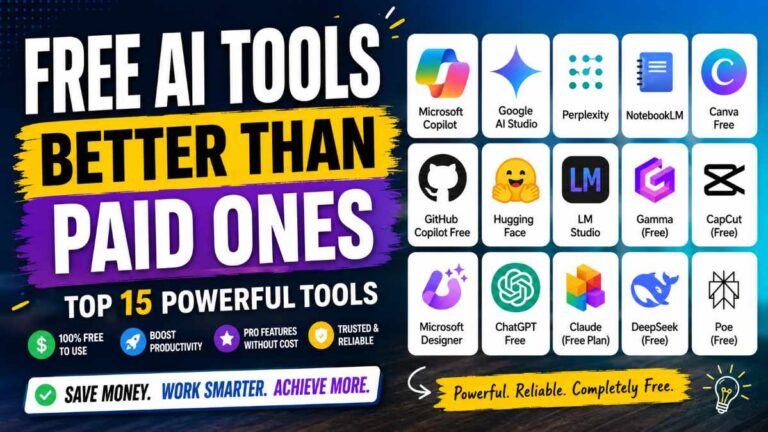
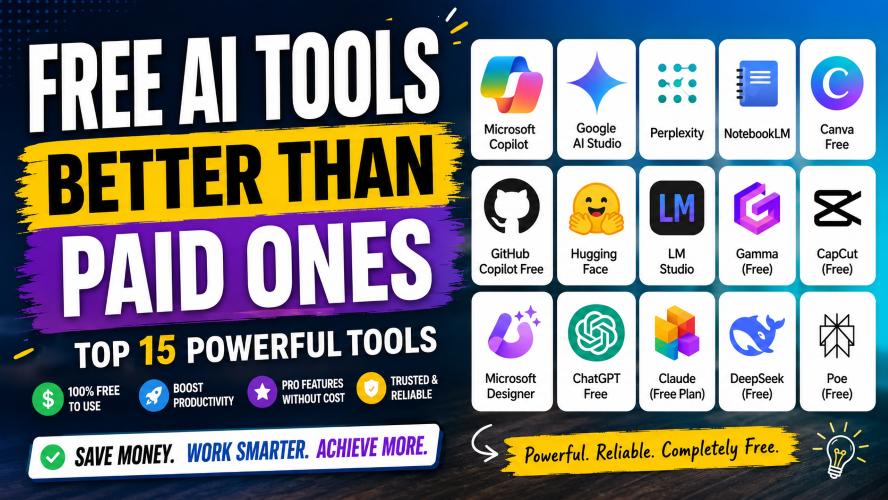
In fact, several free AI platforms now compete directly with paid software by offering generous free tiers, high-quality results, and features that many users never outgrow.
Whether you’re a student, blogger, freelancer, developer, marketer, designer, or small business owner, choosing the right free tool can save hundreds of dollars every year without sacrificing productivity.
This guide highlights some of the most capable free AI tools available today. Instead of focusing on marketing claims, we’ll compare real strengths, practical use cases, limitations, and the types of users who will benefit the most.
By the end of this guide, you’ll know which tools are genuinely worth using—and which paid subscriptions you may not need at all.
Quick Summary
If you’re short on time, here’s a quick overview of our top recommendations.
Need
Recommended Free Tool
Research
Perplexity
Office Productivity
Microsoft Copilot
Study & Notes
NotebookLM
Graphic Design
Canva Free
Coding
GitHub Copilot Free
Open-Source Models
Hugging Face
Local AI
LM Studio
Presentations
Gamma Free
Video Editing
CapCut
Image Creation
Microsoft Designer
The best choice ultimately depends on what you want to accomplish rather than simply picking the tool with the longest feature list.
Why Some Free AI Tools Beat Paid Ones
Many people assume that a paid subscription automatically means better quality.
That isn’t always true.
Several companies offer powerful free plans because they want users to experience their ecosystem before upgrading. Others rely on open-source communities that continuously improve their software without locking essential features behind a paywall.
As a result, today’s best free AI tools often provide:
Excellent performance for everyday work
Frequent updates and improvements
Large user communities
Cross-platform compatibility
Cloud-based access without installation
Enough free usage for students and professionals
Reliable security from established companies
For many users, these features cover nearly all daily tasks, making a premium subscription unnecessary.
What You’ll Learn in This Guide
In the following sections, we’ll compare each tool based on:
Key features
Best use cases
Advantages and disadvantages
Free plan limitations
Who should use it
How it compares with paid alternatives
Whether upgrading is actually worth it
We’ll also include comparison tables, practical scenarios, and tips to help you choose the right option for your workflow instead of paying for features you’ll rarely use.
Best Free AI Tools Better Than Paid Ones
Not every tool on this list tries to replace premium software. Instead, each one excels in a specific area where its free plan is generous enough for most users.
Let’s explore the top picks.
1. Microsoft Copilot
Best for: Everyday productivity, writing, brainstorming, coding, and web assistance
Microsoft Copilot has evolved into one of the most practical free AI assistants available. If you already use Windows, Microsoft Edge, or Microsoft 365, it’s easy to integrate into your daily workflow.
Unlike many free tools that restrict advanced features, Copilot provides a strong balance of conversational assistance, web-based information, document support, and creative tasks without requiring an immediate subscription.
Key Features
Natural conversations
Writing assistance
Email drafting
Code generation
Image creation support
Web search integration
Microsoft ecosystem compatibility
Why It’s Better Than Many Paid Tools
Many premium assistants charge monthly fees simply to help with writing or brainstorming. Copilot covers these common tasks effectively for free, making it a practical option for students, professionals, and casual users.
Pros
Easy to use
Reliable responses
Great Windows integration
Helpful for office work
Strong free plan
Cons
Premium features require Microsoft 365 subscription
Google AI Studio is designed for users who want direct access to powerful AI models through a simple browser interface.
Unlike many consumer-focused assistants, AI Studio provides more flexibility for testing prompts, structured outputs, and longer conversations.
Key Features
Advanced prompt testing
Large context windows
Fast performance
Developer-friendly interface
Multiple model options
Free experimentation
Why It Stands Out
Many paid tools hide advanced capabilities behind expensive subscriptions. AI Studio allows users to experiment with powerful models without immediately committing to a paid plan.
Pros
Excellent prompt control
Fast responses
Ideal for testing workflows
Supports structured outputs
Cons
Interface may feel technical
Not designed for complete beginners
Some advanced usage has quotas
Best For
Developers
Researchers
Prompt engineers
Technical writers
Curious learners
3. Perplexity
Best for: Research and finding trustworthy answers
If your daily work involves searching for reliable information, Perplexity can dramatically reduce research time.
Instead of presenting dozens of search results, it delivers summarized answers along with source citations, making verification much easier.
Key Features
Source-backed answers
Research summaries
Follow-up questions
Web browsing
Fast information retrieval
Clean interface
Why It’s Better Than Many Paid Research Tools
Many research platforms focus on enterprise users. Perplexity provides an excellent free experience that’s more than enough for students, bloggers, marketers, and journalists.
Best for: Studying, note-taking, and document analysis
NotebookLM takes a different approach by helping users work with their own documents instead of relying only on general web knowledge.
Upload notes, PDFs, reports, or study materials, and it helps organize, summarize, and explain the information.
Key Features
Document summaries
Study guides
Question answering
Note organization
Source-aware responses
Multi-document analysis
Why Students Love It
Instead of searching through hundreds of pages manually, NotebookLM helps users understand their own materials more efficiently.
Pros
Excellent learning companion
Easy document management
Saves study time
Great for large PDFs
Cons
Best results require organized documents
Some regional availability may vary
Not intended for creative writing
Best For
University students
Teachers
Researchers
Business analysts
Legal professionals
Real-World Example
Imagine preparing for an exam with 15 lecture PDFs.
Instead of rereading every page, NotebookLM can summarize each lecture, identify key concepts, and help answer questions based on your uploaded materials.
5. Canva Free
Best for: Graphic design and social media content
Canva has become one of the easiest design platforms for beginners.
Even the free version includes thousands of templates, drag-and-drop editing, icons, fonts, presentations, and design tools suitable for personal and business projects.
Key Features
Social media templates
Presentations
Posters
Infographics
Resume builder
Brand elements
Background removal (limited)
Magic design features
Why It’s Better Than Some Paid Design Software
Traditional design software often has steep learning curves and expensive subscriptions.
Canva Free allows almost anyone to create polished visuals within minutes.
Pros
Beginner friendly
Huge template library
Cloud-based
Mobile support
Fast editing
Cons
Some premium templates are locked
Limited brand management
Advanced editing requires Pro
Best For
Bloggers
Small businesses
Students
YouTubers
Social media creators
Common Uses
Pinterest graphics
YouTube thumbnails
Instagram posts
Business presentations
Marketing materials
6. GitHub Copilot Free
Best for: Beginner and intermediate developers
Coding assistants have become increasingly popular, but many require monthly subscriptions.
GitHub Copilot Free offers a useful entry point for developers who want code suggestions inside their editor without paying upfront.
Key Features
Code completion
Function generation
Documentation assistance
Bug fixing suggestions
Multiple language support
IDE integration
Why It’s Worth Trying
For students and hobby developers, the free plan often provides enough assistance for learning, experimenting, and completing smaller projects.
Instead of writing repetitive boilerplate code from scratch, developers can use Copilot to generate a starting point, then review, test, and customize it before deployment.
Quick Comparison Table
Tool
Best For
Free Plan Value
Ideal User
Microsoft Copilot
Productivity
★★★★★
Professionals, students
Google AI Studio
Advanced experimentation
★★★★★
Developers, researchers
Perplexity
Research
★★★★★
Writers, marketers
NotebookLM
Learning
★★★★★
Students, analysts
Canva Free
Design
★★★★☆
Creators, businesses
GitHub Copilot Free
Coding
★★★★☆
Developers
7. Hugging Face
Best for: Exploring open-source AI models
If you enjoy experimenting with different AI models, Hugging Face is one of the best places to start.
Instead of relying on a single assistant, it provides access to thousands of community-built models for writing, coding, translation, image generation, speech recognition, and much more.
Many of these models are completely free to use.
Key Features
Thousands of open-source models
Ready-to-use demos
Model comparisons
Developer APIs
Large community support
Frequent updates
Why It’s Better Than Some Paid Platforms
Many paid services only let you use their own models. Hugging Face gives you the freedom to choose from a wide range of models based on your needs, making it ideal for experimentation and learning.
Pros
Massive collection of models
Strong developer community
Free access to many tools
Great learning resource
Cons
Can be overwhelming for beginners
Some advanced features require technical knowledge
Performance varies between models
Best For
Developers
Data scientists
AI enthusiasts
Researchers
8. LM Studio
Best for: Running AI models locally
Privacy is becoming a bigger concern for many users.
LM Studio allows you to download compatible AI models and run them directly on your own computer, reducing the need to send your data to external servers.
For users with capable hardware, this is a powerful alternative to cloud-based subscriptions.
Key Features
Offline AI usage
Local model management
Privacy-focused
Supports multiple open-source models
Simple desktop interface
Why It Stands Out
Unlike subscription services that charge monthly fees for cloud access, LM Studio lets you use compatible models locally after downloading them.
Pros
Excellent privacy
No recurring subscription
Works offline
Flexible model selection
Cons
Requires a modern computer
Initial downloads can be large
Performance depends on hardware
Best For
Developers
Privacy-conscious users
Researchers
Advanced users
9. Gamma
Best for: Creating presentations quickly
Building presentations from scratch often takes longer than expected.
Gamma helps simplify the process by generating clean layouts, organizing content, and producing professional-looking slides with minimal effort.
Its free plan is generous enough for students, educators, freelancers, and many business users.
Key Features
Presentation creation
Document formatting
Built-in themes
Collaboration
Easy editing
Export options
Why It’s Better Than Traditional Presentation Software
Instead of spending hours arranging text boxes and images, Gamma focuses on content first and handles much of the design automatically.
Pros
Fast presentation creation
Modern layouts
Easy collaboration
Beginner friendly
Cons
Limited exports on free plan
Premium themes require subscription
Customization isn’t unlimited
Best For
Students
Teachers
Consultants
Startup founders
10. CapCut
Best for: Video editing
Professional video editing software can be expensive and intimidating.
CapCut offers an impressive collection of editing tools for free, making it one of the most popular choices among content creators.
Key Features
Timeline editing
Automatic captions
Background removal
Video effects
Transitions
Audio editing
Mobile and desktop versions
Why Many Creators Prefer It
For YouTube Shorts, Instagram Reels, TikTok videos, and marketing clips, CapCut provides enough functionality that many creators never need expensive editing software.
Pros
Easy to learn
Powerful editing tools
Excellent templates
Frequent updates
Cons
Some advanced assets require Pro
Watermark rules vary depending on templates
Cloud storage limits
Best For
YouTubers
Social media creators
Freelancers
Small businesses
Practical Example
Need to edit a product review video?
You can trim clips, add captions, include transitions, insert background music, and export in high quality without purchasing premium software.
11. Microsoft Designer
Best for: Quick image creation and marketing graphics
Creating social media graphics no longer requires advanced design skills.
Microsoft Designer helps users create banners, thumbnails, invitations, advertisements, and promotional graphics within minutes.
Key Features
Graphic templates
Social media designs
Marketing assets
Background editing
Image enhancement
Easy sharing
Why It’s Better Than Some Paid Design Apps
Many premium tools target professional designers.
Designer focuses on speed, simplicity, and everyday content creation, making it perfect for bloggers and small businesses.
Pros
Clean interface
Fast workflow
Beginner friendly
Good template selection
Cons
Advanced editing is limited
Fewer customization options than professional software
Internet connection required
Best For
Bloggers
Affiliate marketers
Online stores
Social media managers
Paid vs. Free AI Tools: Is Paying Always Better?
Not necessarily.
For many users, a free plan covers 80–90% of everyday tasks. Paid plans often add higher usage limits, faster processing, collaboration features, or enterprise tools rather than dramatically improving output quality.
Feature
Free Tools
Paid Tools
Basic writing
✅
✅
Research
✅
✅
Coding help
✅
✅
Graphic design
✅
✅
Collaboration
Limited
Extensive
Usage limits
Yes
Higher or none
Priority support
No
Yes
Enterprise features
Rare
Common
Monthly cost
$0
Usually recurring
How to Choose the Right Free AI Tool
Before signing up for any platform, ask yourself these questions:
What is your primary goal?
Writing and productivity
Research
Coding
Graphic design
Video editing
Studying
Presentations
Choosing a specialized tool often produces better results than trying to use one platform for everything.
How often will you use it?
Occasional users usually won’t hit free plan limits.
Daily professionals may eventually benefit from premium plans with higher quotas and collaboration features.
Do you need privacy?
If you work with sensitive information, consider tools that support local processing or provide clear privacy controls.
Is collaboration important?
Teams often benefit from paid plans that include shared workspaces, version history, and administrative controls.
Real-World Scenarios
Student
A university student can combine:
NotebookLM for studying
Canva Free for presentations
Perplexity for research
This combination covers most academic needs without a monthly subscription.
Blogger
A blogger might use:
Microsoft Copilot for drafting
Perplexity for fact-checking
Microsoft Designer for featured images
Canva Free for social graphics
Small Business Owner
A small business can rely on:
Canva Free for marketing
CapCut for promotional videos
Microsoft Copilot for emails and documents
Gamma for client presentations
This setup reduces software costs while supporting everyday business tasks.
Things to Consider Before Choosing a Free AI Tool
A free plan can be surprisingly capable, but the best option depends on how you plan to use it. Before creating an account, keep these factors in mind.
1. Your Primary Use Case
Start by identifying the task you need help with.
Writing and editing
Research and learning
Graphic design
Video editing
Coding
Presentations
Business productivity
Choosing a specialized tool usually delivers better results than trying to use one platform for everything.
2. Free Plan Limitations
Most free tools include reasonable limits.
Look for:
Daily or monthly usage caps
File upload limits
Export restrictions
Watermarks
Limited cloud storage
If these limits don’t affect your workflow, there’s little reason to upgrade.
3. Ease of Use
A powerful tool isn’t always the best choice.
If you’re a beginner, prioritize software with:
Clean interface
Helpful tutorials
Good documentation
Active community support
Learning a simple tool quickly often saves more time than mastering a feature-heavy platform.
4. Privacy and Security
If you work with sensitive business documents or personal information, review the platform’s privacy policy and data handling practices.
Consider:
Local processing options
Account security
Data retention policies
File encryption
Permission settings
5. Upgrade Only When It Makes Sense
Many users upgrade too early.
A paid plan is worth considering only if you regularly need:
Higher usage limits
Faster processing
Team collaboration
Priority support
Advanced automation
Enterprise-level features
Otherwise, the free version may continue to meet your needs.
Quick Recommendation by User Type
User
Recommended Tool
Students
NotebookLM, Perplexity, Canva Free
Bloggers
Microsoft Copilot, Canva Free, Microsoft Designer
Developers
GitHub Copilot Free, Google AI Studio, LM Studio
Designers
Canva Free, Microsoft Designer
Researchers
Perplexity, NotebookLM
Small Businesses
Microsoft Copilot, Gamma, CapCut
Content Creators
Canva Free, CapCut, Microsoft Designer
Frequently Asked Questions (FAQs)
1. Are free AI tools really good enough?
Yes. For many everyday tasks such as writing, research, studying, coding, presentations, and graphic design, today’s free tools provide more than enough functionality. Premium plans mainly increase usage limits or unlock advanced features.
2. Which free AI tool is best for students?
NotebookLM is an excellent choice for organizing study materials and summarizing documents. Perplexity is also useful for research, while Canva Free works well for presentations and assignments.
3. Can businesses rely on free AI tools?
Small businesses can use free tools for many daily tasks, including creating marketing materials, drafting emails, editing videos, and preparing presentations. As a business grows, paid plans may become worthwhile for collaboration and higher limits.
4. Are paid AI tools always better?
Not always. Paid plans often offer convenience, larger quotas, and premium support rather than dramatically better results. Many users find that free versions cover their regular workflow.
5. Which free AI tool is best for content creators?
Canva Free is ideal for graphics, CapCut is excellent for video editing, and Microsoft Designer is a strong choice for creating promotional visuals.
6. What should I check before upgrading to a paid plan?
Evaluate whether you’re consistently reaching free plan limits. If your current tool handles your workload without restrictions, upgrading may not provide enough additional value.
7. Can I use multiple free AI tools together?
Absolutely. Many users combine different tools for specific tasks. For example, one tool for research, another for design, and another for coding or productivity often creates a more efficient workflow than relying on a single platform.
Final Comparison Table
Tool
Best For
Beginner Friendly
Free Plan Rating
Microsoft Copilot
Productivity
⭐⭐⭐⭐⭐
⭐⭐⭐⭐⭐
Google AI Studio
Advanced workflows
⭐⭐⭐
⭐⭐⭐⭐⭐
Perplexity
Research
⭐⭐⭐⭐⭐
⭐⭐⭐⭐⭐
NotebookLM
Studying
⭐⭐⭐⭐⭐
⭐⭐⭐⭐⭐
Canva Free
Design
⭐⭐⭐⭐⭐
⭐⭐⭐⭐☆
GitHub Copilot Free
Coding
⭐⭐⭐⭐☆
⭐⭐⭐⭐☆
Hugging Face
Open-source models
⭐⭐⭐
⭐⭐⭐⭐⭐
LM Studio
Local models
⭐⭐⭐
⭐⭐⭐⭐☆
Gamma
Presentations
⭐⭐⭐⭐⭐
⭐⭐⭐⭐☆
CapCut
Video editing
⭐⭐⭐⭐⭐
⭐⭐⭐⭐☆
Microsoft Designer
Graphics
⭐⭐⭐⭐⭐
⭐⭐⭐⭐☆
Final Verdict
The idea that you need an expensive subscription to be productive is becoming less true every year.
Many free AI tools now provide enough features for students, freelancers, creators, developers, and small business owners to complete everyday work without paying a monthly fee.
If you’re just getting started, focus on building a toolkit that matches your needs instead of choosing the platform with the longest feature list.
For most users, these combinations offer excellent value:
Productivity: Microsoft Copilot + Perplexity
Learning: NotebookLM + Perplexity
Design: Canva Free + Microsoft Designer
Coding: GitHub Copilot Free + Google AI Studio
Content Creation: Canva Free + CapCut
Business: Microsoft Copilot + Gamma
As your projects become more demanding, you can explore premium plans for additional capacity and collaboration features. Until then, the free options highlighted in this guide are capable enough to help you work smarter without increasing your software budget.
Key Takeaways
Free tools can meet the needs of many users without a subscription.
Choose tools based on your specific workflow rather than popularity.
Compare free plan limits before paying for premium features.
Combining specialized tools often works better than relying on a single all-in-one platform.
Upgrade only when your workload genuinely requires additional features or higher usage limits.
Artificial intelligence has become one of the most useful technologies for students, professionals, developers, marketers, and businesses. Whether you need help writing emails, creating content, analyzing documents, generating code, or researching complex topics, there’s now an AI assistant designed for the job.
The challenge isn’t finding an AI model anymore, it’s choosing the right one.
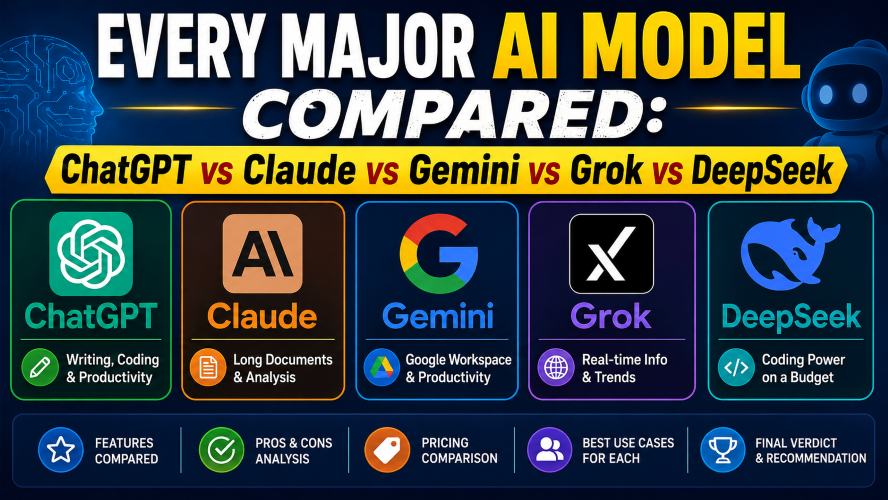
Today, five names dominate the conversation:
• ChatGPT • Claude • Gemini • Grok • DeepSeek
Each platform has unique strengths. Some are excellent for coding, while others are better for writing, research, or working with large documents. Choosing the wrong one could mean paying for features you’ll never use or missing out on tools that could save you hours every week.
In this detailed comparison, we’ll examine every major AI model side by side, looking at their features, performance, pricing, strengths, weaknesses, and ideal use cases. By the end, you’ll know exactly which one fits your workflow and budget.
ChatGPT vs Claude vs Gemini vs Grok vs DeepSeek
Quick Summary
Don’t have time to read the full guide? Here’s a quick overview.
AI Model
Best For
Overall Rating
ChatGPT
Writing, coding, productivity
⭐⭐⭐⭐⭐
Claude
Long documents and analysis
⭐⭐⭐⭐⭐
Gemini
Google Workspace users
⭐⭐⭐⭐☆
Grok
Real-time information
⭐⭐⭐⭐☆
DeepSeek
Coding on a budget
⭐⭐⭐⭐☆
Quick Recommendations
✅ Choose ChatGPT if you want the most balanced AI assistant for everyday tasks.
✅ Choose Claude if you regularly work with long reports, PDFs, or business documents.
✅ Choose Gemini if you rely heavily on Gmail, Google Docs, and Google Drive.
✅ Choose Grok if you want quick access to current trends and real-time information.
✅ Choose DeepSeek if you’re looking for strong coding performance without spending a lot.
Why This Comparison Matters
Many people assume every AI assistant works the same way.
That’s simply not true.
Although all of these models can answer questions and generate text, they perform very differently depending on the task.
Some models excel at programming.
Others are designed for research.
Some produce more natural writing, while others focus on reasoning or handling massive documents.
Understanding these differences helps you:
• Save time • Choose the right subscription • Improve productivity • Avoid paying for unnecessary features • Get better results from your AI assistant
Instead of relying on marketing claims, this guide focuses on practical performance and real-world use cases.
ChatGPT has become one of the world’s most popular AI assistants because it performs consistently well across almost every category. Rather than specializing in just one area, it provides a balanced mix of writing, coding, research, creativity, and productivity features.
Whether you’re a student preparing assignments, a content creator publishing articles, a developer writing code, or a business professional managing projects, ChatGPT adapts well to different workflows.
Some of the most common tasks people use ChatGPT for include:
• Writing emails • Creating blog outlines • Explaining complex concepts • Summarizing articles and PDFs • Brainstorming business ideas • Debugging code • Creating spreadsheets • Drafting reports • Translating languages • Improving existing content
Its flexibility makes it one of the safest choices for users who want a single AI assistant capable of handling a wide variety of everyday tasks.
Key Features of ChatGPT
Excellent Writing Assistance
One of ChatGPT’s biggest strengths is its ability to produce natural, easy-to-read content. Whether you’re writing for business, education, or marketing, it delivers well-structured responses that require minimal editing.
It performs particularly well for:
• Blog posts • Emails • Reports • Social media captions • Product descriptions • Marketing copy • Website content
It can also rewrite existing content, improve grammar, simplify complex sentences, or adjust the tone to match your audience.
Strong Coding Support
ChatGPT is also a favorite among developers because it supports many popular programming languages.
It can help with:
• Python • JavaScript • Java • C++ • SQL • HTML & CSS • React • APIs
Beyond writing code, it can explain programming concepts, debug errors, suggest improvements, optimize existing code, and even guide beginners through difficult coding problems.
Productivity Features
ChatGPT isn’t just for writing or coding—it can also help you stay organized.
Some popular productivity tasks include:
• Creating daily to-do lists • Planning projects • Organizing research notes • Summarizing meeting notes • Drafting business proposals • Brainstorming marketing campaigns • Building study plans
These capabilities make it useful for freelancers, students, entrepreneurs, and teams looking to streamline their daily work.
Image Understanding
Depending on your subscription and available features, ChatGPT can analyze visual content such as:
• Some advanced features require a paid subscription.
• The quality of responses depends on how clearly your prompt is written.
• Highly specialized professional software may still be better for certain technical tasks.
Who Should Choose ChatGPT?
ChatGPT is an excellent option if you:
• Write content regularly
• Need help with coding
• Want an AI assistant for everyday work
• Manage business projects
• Study complex subjects
• Frequently summarize articles or documents
• Need quick brainstorming assistance
For most users, ChatGPT offers one of the best balances between ease of use, versatility, and overall performance. It performs well across a wide range of tasks, making it a reliable choice for both beginners and experienced users.
Claude Overview
Best For
• Long documents and PDFs • Research and analysis • Business writing • Academic work • Professional reports • Detailed explanations
Claude has earned a strong reputation for handling large amounts of information without losing context. If your daily work involves reading lengthy reports, analyzing research papers, or reviewing contracts, Claude is one of the strongest options available.
Unlike many AI assistants that may lose track of earlier conversations, Claude is designed to maintain context over much longer discussions. This makes it especially useful for professionals who need detailed analysis rather than short answers.
Another area where Claude stands out is its writing style. Its responses are often well-organized, thoughtful, and easy to read, making it a favorite among writers, researchers, consultants, and business professionals.
Key Features of Claude
Excellent Long Document Analysis
Claude performs exceptionally well when working with large files.
It can help you:
• Summarize research papers
• Review business reports
• Analyze legal documents
• Understand technical manuals
• Extract important information from lengthy PDFs
Instead of simply shortening documents, Claude often identifies key insights and presents them in a structured format that’s easy to understand.
High-Quality Writing
If your work involves professional communication, Claude produces polished and natural writing.
It works well for:
• Business proposals
• Professional emails
• Executive summaries
• Reports
• Documentation
• Educational content
Many users appreciate its calm and structured writing style, especially when preparing formal documents.
Strong Reasoning Ability
Claude is particularly effective at tasks that require careful thinking.
Examples include:
• Comparing multiple options
• Planning projects
• Breaking down complex topics
• Explaining technical concepts
• Solving multi-step problems
Its responses tend to include logical reasoning rather than simply giving short answers.
Pros of Claude
✔ Excellent document analysis
✔ Handles very long conversations
✔ Natural and professional writing
✔ Strong reasoning capabilities
✔ Great for research and business work
✔ Easy-to-understand explanations
Cons of Claude
• Fewer ecosystem integrations compared to some competitors.
• Real-time web information may depend on the version or plan being used.
• Less focused on creative image generation than some alternatives.
Who Should Choose Claude?
Claude is an excellent choice if you regularly:
• Read lengthy documents
• Write business reports
• Analyze research papers
• Prepare presentations
• Study complex subjects
• Need detailed explanations
For professionals who spend hours working with documents every week, Claude can become a valuable productivity tool.
Gemini Overview
Best For
• Google Workspace users
• Gmail productivity
• Google Docs
• Google Sheets
• Research
• Everyday assistance
Gemini is Google’s AI assistant and is designed to work closely with Google’s ecosystem. If you already use Gmail, Google Drive, Google Docs, Google Sheets, or Google Calendar every day, Gemini offers a convenient experience by integrating directly with those services.
Rather than switching between multiple apps, users can often perform tasks from within Google’s own workspace.
This makes Gemini particularly attractive for students, professionals, and businesses already invested in Google’s products.
Key Features of Gemini
Deep Google Workspace Integration
Gemini works well with popular Google services, including:
• Gmail
• Google Docs
• Google Sheets
• Google Slides
• Google Drive
• Google Calendar
This integration can simplify everyday workflows by helping users organize information, draft content, summarize emails, and manage documents more efficiently.
Helpful Research Assistance
Gemini performs well when researching topics.
It can help with:
• Explaining concepts
• Summarizing information
• Comparing products
• Brainstorming ideas
• Creating study notes
Students and researchers often appreciate its ability to organize information into clear, structured summaries.
Productivity Focus
Gemini is designed to improve day-to-day productivity.
It can assist with:
• Email drafting
• Meeting preparation
• Project planning
• Presentation outlines
• Spreadsheet formulas
• Document editing
For users already working inside Google’s ecosystem, these features can reduce repetitive tasks.
• Users outside Google’s ecosystem may not benefit as much from its integrations.
• Coding performance, while good, may not always match specialized coding-focused models.
Who Should Choose Gemini?
Gemini is ideal if you:
• Use Gmail daily
• Store files in Google Drive
• Create documents in Google Docs
• Work with spreadsheets
• Need help organizing projects
• Prefer Google’s ecosystem
If your workflow already revolves around Google services, Gemini can become a natural extension of your daily routine.
Grok Overview
Best For
• Current events
• Trending topics
• Social media discussions
• Fast answers
• Casual conversations
Grok is designed with a different approach compared to many traditional AI assistants. It focuses on providing conversational responses while emphasizing access to recent information and online discussions.
For users who frequently follow breaking news, technology updates, or social media trends, Grok offers an experience centered around timely information.
It also has a conversational style that many users find engaging and informal.
Key Features of Grok
Access to Recent Information
One of Grok’s biggest strengths is helping users explore recent topics such as:
• Technology news
• Market trends
• Sports updates
• Entertainment news
• Social media discussions
This makes it particularly useful for users who want information that changes quickly.
Fast Responses
Grok is designed to deliver answers quickly while maintaining a conversational tone.
It performs well for:
• Quick research
• Brainstorming
• General questions
• Trend analysis
Pros of Grok
✔ Good access to current information
✔ Fast responses
✔ Easy conversational style
✔ Useful for trending topics
✔ Great for casual research
Cons of Grok
• Fewer productivity integrations than some competitors.
• Business-focused workflows are not its primary strength.
• Long document analysis may not be as strong as Claude.
Who Should Choose Grok?
Choose Grok if you:
• Follow daily news
• Monitor technology trends
• Spend time on social platforms
• Need quick answers
• Prefer a conversational experience
DeepSeek Overview
Best For
• Software development
• Programming
• Budget-conscious users
• Technical learning
• Code generation
DeepSeek has gained attention for delivering impressive coding performance while remaining accessible to users who don’t want expensive subscriptions.
Although it also handles writing and general conversations, its biggest strength lies in software development.
Developers often use DeepSeek to generate code, explain algorithms, debug applications, and learn new programming languages.
Key Features of DeepSeek
Excellent Coding Performance
DeepSeek supports a wide variety of programming tasks, including:
• Python
• JavaScript
• Java
• C++
• SQL
• HTML
• CSS
• API development
It can also explain code line by line, making it valuable for beginners learning programming.
Fast Technical Assistance
Developers frequently use DeepSeek for:
• Debugging
• Code optimization
• Refactoring
• Learning frameworks
• Building sample projects
Its responses are often concise and focused on solving technical problems.
Good Value for Money
DeepSeek has become popular among users looking for strong performance without paying premium prices.
For freelancers, students, and independent developers, it offers an attractive balance between capability and affordability.
Pros of DeepSeek
✔ Excellent coding assistance
✔ Good technical explanations
✔ Beginner-friendly for programmers
✔ Strong value for money
✔ Fast responses
✔ Helpful for software development
Cons of DeepSeek
• General writing quality may not always match ChatGPT or Claude.
• Business productivity features are more limited.
• Fewer integrations with third-party productivity tools.
Who Should Choose DeepSeek?
DeepSeek is an excellent option if you:
• Write code every day
• Learn programming
• Build websites or applications
• Need debugging assistance
• Want a capable AI assistant without spending a lot
Feature Comparison at a Glance
Feature
ChatGPT
Claude
Gemini
Grok
DeepSeek
Writing Quality
⭐⭐⭐⭐⭐
⭐⭐⭐⭐⭐
⭐⭐⭐⭐☆
⭐⭐⭐⭐☆
⭐⭐⭐⭐☆
Coding
⭐⭐⭐⭐⭐
⭐⭐⭐⭐☆
⭐⭐⭐⭐☆
⭐⭐⭐☆☆
⭐⭐⭐⭐⭐
Research
⭐⭐⭐⭐⭐
⭐⭐⭐⭐⭐
⭐⭐⭐⭐☆
⭐⭐⭐⭐☆
⭐⭐⭐⭐☆
Long Documents
⭐⭐⭐⭐☆
⭐⭐⭐⭐⭐
⭐⭐⭐⭐☆
⭐⭐⭐☆☆
⭐⭐⭐☆☆
Productivity
⭐⭐⭐⭐⭐
⭐⭐⭐⭐☆
⭐⭐⭐⭐⭐
⭐⭐⭐☆☆
⭐⭐⭐⭐☆
Ease of Use
⭐⭐⭐⭐⭐
⭐⭐⭐⭐⭐
⭐⭐⭐⭐⭐
⭐⭐⭐⭐☆
⭐⭐⭐⭐☆
Best Value
⭐⭐⭐⭐☆
⭐⭐⭐⭐☆
⭐⭐⭐⭐☆
⭐⭐⭐⭐☆
⭐⭐⭐⭐⭐
Head-to-Head Comparison: Which AI Model Performs Best?
Now that we’ve explored each AI model individually, it’s time to compare them side by side. While all five models are capable of answering questions, generating content, and assisting with everyday tasks, each one has areas where it clearly performs better than the others.
Let’s compare them across the categories that matter most.
1. Writing Quality
If your primary goal is creating high-quality content, writing emails, drafting reports, or improving existing text, writing quality should be your top priority.
ChatGPT
ChatGPT produces natural, engaging, and versatile content. It adapts well to different writing styles, whether you need a professional business email, a blog post, marketing copy, or casual content.
It also follows instructions well, making it easier to control tone, length, and formatting.
Best for:
Blog writing
Marketing copy
Product descriptions
Social media content
Business emails
Rating: ⭐⭐⭐⭐⭐
Claude
Claude focuses on clarity and structure. Its writing feels polished, professional, and easy to read, making it particularly useful for business communication and detailed documentation.
It also performs exceptionally well when rewriting or editing long pieces of text.
Best for:
Reports
Research summaries
Professional communication
Documentation
Academic writing
Rating: ⭐⭐⭐⭐⭐
Gemini
Gemini creates clean and informative content, especially for educational topics and productivity tasks. It integrates well with Google Workspace, making document creation convenient for existing Google users.
Rating: ⭐⭐⭐⭐☆
Grok
Grok’s writing style is conversational and relaxed. It performs well for quick responses, summaries, and discussions about current events but is generally less polished for long-form professional writing.
Rating: ⭐⭐⭐⭐☆
DeepSeek
DeepSeek generates clear technical explanations and straightforward content. While it’s excellent for programming-related documentation, creative writing and marketing content may require additional editing.
Rating: ⭐⭐⭐⭐☆
Winner for Writing
🥇 Tie: ChatGPT & Claude
Choose ChatGPT for creative and marketing content.
Choose Claude for business documents, reports, and structured writing.
2. Coding Performance
Developers often rely on AI assistants to generate code, fix bugs, explain algorithms, and speed up development.
Here’s how the models compare.
ChatGPT
ChatGPT remains one of the strongest coding assistants available.
It supports numerous programming languages and can:
Generate complete functions
Explain code line by line
Debug errors
Suggest improvements
Build project structures
It also works well for beginners learning programming.
Rating: ⭐⭐⭐⭐⭐
Claude
Claude performs well for understanding complex codebases and explaining technical concepts. It also handles long code files effectively, making it useful for software documentation and code reviews.
Rating: ⭐⭐⭐⭐☆
Gemini
Gemini offers reliable coding assistance and is especially useful for developers who work within Google’s ecosystem or Android development.
Rating: ⭐⭐⭐⭐☆
Grok
Grok can generate and explain code but currently focuses more on general conversations and current information than advanced software development.
Rating: ⭐⭐⭐☆☆
DeepSeek
DeepSeek has quickly become a favorite among programmers because of its impressive coding capabilities.
It performs particularly well for:
Python
JavaScript
C++
Java
SQL
Algorithm explanations
Debugging
Code optimization
Many developers appreciate its technical accuracy and speed.
Rating: ⭐⭐⭐⭐⭐
Winner for Coding
🥇 Tie: ChatGPT & DeepSeek
Choose ChatGPT for an all-around development assistant.
Choose DeepSeek if programming is your primary use case.
3. Research and Information Analysis
Research isn’t just about finding information—it’s about understanding, organizing, and explaining it clearly.
ChatGPT
ChatGPT excels at summarizing articles, organizing ideas, and simplifying complex topics into easy-to-understand explanations.
It also works well for brainstorming and comparing multiple viewpoints.
Rating: ⭐⭐⭐⭐⭐
Claude
Claude shines when working with lengthy research papers, reports, and technical documentation.
Its ability to maintain context across large documents makes it one of the strongest research assistants available.
Rating: ⭐⭐⭐⭐⭐
Gemini
Gemini provides accurate summaries and integrates well with Google services, making research convenient for students and professionals.
Rating: ⭐⭐⭐⭐☆
Grok
Grok performs well when researching current events, trending topics, and recent discussions.
Rating: ⭐⭐⭐⭐☆
DeepSeek
DeepSeek offers solid research capabilities, particularly for technical subjects, programming, and engineering topics.
Rating: ⭐⭐⭐⭐☆
Winner for Research
🥇 Claude
For large reports, PDFs, and academic material, Claude stands out as the strongest option.
4. Productivity Features
Many users depend on AI assistants to organize their work, manage projects, and save time.
Here’s how they compare.
ChatGPT
ChatGPT offers a balanced set of productivity features, helping users create plans, summarize meetings, organize projects, draft emails, and generate documents.
Its flexibility makes it suitable for both personal and professional use.
Rating: ⭐⭐⭐⭐⭐
Claude
Claude is excellent for document-heavy workflows and business communication but offers fewer productivity integrations than some competitors.
Rating: ⭐⭐⭐⭐☆
Gemini
Gemini’s biggest advantage is its integration with Google Workspace.
Users can work with:
Gmail
Google Docs
Google Sheets
Google Drive
Google Calendar
This makes it particularly valuable for teams already using Google’s ecosystem.
Rating: ⭐⭐⭐⭐⭐
Grok
Grok is useful for quick questions and brainstorming but isn’t primarily designed as a productivity platform.
Rating: ⭐⭐⭐☆☆
DeepSeek
DeepSeek supports productivity tasks but focuses more on technical work than business workflows.
Rating: ⭐⭐⭐⭐☆
Winner for Productivity
🥇 Tie: ChatGPT & Gemini
Choose ChatGPT for flexibility.
Choose Gemini if your workflow revolves around Google Workspace.
5. Ease of Use
A powerful AI assistant should also be simple to use.
Here’s how beginner-friendly each model is.
AI Model
Ease of Use
ChatGPT
⭐⭐⭐⭐⭐
Claude
⭐⭐⭐⭐⭐
Gemini
⭐⭐⭐⭐⭐
Grok
⭐⭐⭐⭐☆
DeepSeek
⭐⭐⭐⭐☆
All five models are relatively easy to use, but ChatGPT, Claude, and Gemini offer the smoothest experience for first-time users.
6. Pricing Comparison
Pricing can be a deciding factor, especially if you plan to use an AI assistant every day.
AI Model
Free Version
Paid Plan Available
Good Value
ChatGPT
Yes
Yes
⭐⭐⭐⭐⭐
Claude
Yes
Yes
⭐⭐⭐⭐☆
Gemini
Yes
Yes
⭐⭐⭐⭐☆
Grok
Limited
Yes
⭐⭐⭐⭐☆
DeepSeek
Yes
Yes
⭐⭐⭐⭐⭐
If you’re looking for excellent value, ChatGPT and DeepSeek provide some of the strongest free and paid options depending on your needs.
Best AI Model for Different Users
Choosing the right AI assistant depends on how you plan to use it. Here’s a quick guide to help you decide.
If You Are…
Recommended AI Model
Student
ChatGPT or Gemini
Blogger
ChatGPT
Content Writer
ChatGPT or Claude
Software Developer
DeepSeek or ChatGPT
Business Professional
Claude
Researcher
Claude
Google Workspace User
Gemini
Entrepreneur
ChatGPT
Marketing Professional
ChatGPT
Budget-Conscious User
DeepSeek
Quick Decision Guide
Still unsure which AI model is right for you? Use this simple guide:
Choose ChatGPT if you want one AI assistant that performs well across writing, coding, productivity, and everyday tasks.
Choose Claude if your work involves long documents, reports, research, or professional writing.
Choose Gemini if you already rely on Google Workspace and want seamless integration with Gmail, Docs, and Drive.
Choose Grok if staying updated on current events and trending topics is your priority.
Choose DeepSeek if you’re a developer looking for strong coding capabilities at an affordable price.
Real-World Use Cases: Which AI Model Fits Your Workflow?
The best AI model isn’t necessarily the one with the most features—it’s the one that matches your daily tasks. Here’s how each model performs in real-world scenarios.
For Students
Students often need help with:
Understanding complex topics
Summarizing textbooks
Creating study notes
Preparing presentations
Practicing interview questions
Organizing assignments
Recommended: ChatGPT or Gemini
ChatGPT is excellent for explaining difficult concepts in simple language, while Gemini is a great option for students already using Google Classroom, Google Docs, and Google Drive.
For Bloggers and Content Creators
Creating high-quality content consistently takes time. An AI assistant can help with:
Blog outlines
Article research
Content ideas
SEO-friendly headings
Email newsletters
Social media captions
Recommended: ChatGPT
Its versatility and ability to adapt to different writing styles make it an excellent choice for content creators.
For Developers
Developers can save significant time by using AI for:
Writing code
Debugging errors
Learning new frameworks
Explaining complex functions
Code optimization
Documentation
Recommended: DeepSeek or ChatGPT
DeepSeek shines in technical programming tasks, while ChatGPT offers a balanced combination of coding assistance, documentation, and explanations.
For Business Professionals
Professionals often need support with:
Business reports
Executive summaries
Meeting notes
Professional emails
Research
Strategic planning
Recommended: Claude
Claude’s structured writing style and strong reasoning capabilities make it a valuable tool for business communication.
For Researchers
If your work involves reading long reports or academic papers, you’ll benefit from an AI assistant that can process large amounts of information without losing context.
Recommended: Claude
Its ability to summarize lengthy documents and provide detailed analysis makes research much easier.
For Small Business Owners
Business owners often juggle multiple responsibilities, including marketing, customer communication, planning, and administration.
A capable AI assistant can help create marketing content, organize ideas, draft emails, and improve productivity.
Recommended: ChatGPT
Its versatility makes it well-suited for handling a wide variety of business tasks.
Things to Consider Before Choosing an AI Model
Before subscribing to any AI service, think about how you plan to use it.
1. Your Primary Use Case
Ask yourself:
Will you mostly write content?
Do you need coding assistance?
Are you researching large documents?
Do you work inside Google Workspace?
Is real-time information important?
Your answer will quickly narrow down the best option.
2. Budget
Most major AI platforms offer free versions, but premium plans unlock additional features, faster performance, and higher usage limits.
If you’re just getting started, try the free version before committing to a paid subscription.
3. Integrations
Some AI models work better with specific ecosystems.
For example:
Google users may prefer Gemini.
Users who need document-heavy workflows may prefer Claude.
Developers may prefer DeepSeek.
Users looking for an all-purpose assistant may find ChatGPT to be the most versatile.
4. Learning Curve
Although today’s AI assistants are beginner-friendly, some offer more intuitive interfaces and smoother workflows than others.
If you’re new to AI, choosing a platform with a simple interface can make the learning process much easier.
Frequently Asked Questions (FAQs)
1. Which AI model is the best overall?
There isn’t a single answer for everyone. If you need one assistant that performs well across writing, coding, research, and productivity, ChatGPT is one of the most balanced choices. However, users with specialized needs may find Claude, Gemini, Grok, or DeepSeek better suited to their workflow.
2. Which AI model is best for coding?
DeepSeek and ChatGPT are both excellent choices for programming tasks. They support multiple programming languages, assist with debugging, explain code, and help developers learn new concepts.
3. Which AI assistant is best for writing?
For creative writing, blog posts, and marketing content, ChatGPT performs exceptionally well. If your focus is business reports, documentation, or long-form professional writing, Claude is an excellent alternative.
4. Which AI model is best for students?
Students should consider ChatGPT or Gemini. Both can explain complex concepts, summarize study materials, assist with assignments, and support everyday learning.
5. Is it worth paying for a premium AI subscription?
If you use an AI assistant regularly for work, study, or business, a premium plan can provide access to advanced models, higher usage limits, faster responses, and additional productivity features. Casual users may find the free plans sufficient.
6. Which AI model works best with Google services?
Gemini is designed to integrate closely with Google Workspace, making it a convenient choice for users who rely on Gmail, Google Docs, Google Sheets, Google Drive, and Google Calendar.
7. Can I use more than one AI model?
Yes. Many professionals use different AI models for different tasks. For example, one model may be better for writing, while another excels at coding or document analysis. Choosing the right tool for each task can improve efficiency.
Final Verdict
Choosing the right AI model ultimately comes down to your goals, workflow, and preferred ecosystem. While every model in this comparison is capable of handling everyday tasks, each has its own strengths.
If you want a well-rounded assistant for writing, coding, brainstorming, research, and productivity, ChatGPT remains one of the most versatile choices.
If your work revolves around long documents, reports, or detailed analysis, Claude stands out for its strong reasoning and document-handling capabilities.
For users deeply invested in Google’s ecosystem, Gemini offers seamless integration with Gmail, Google Docs, Drive, and other Workspace tools, making everyday productivity more convenient.
If staying informed about current events and trending topics is your priority, Grok provides quick access to recent information in a conversational format.
For developers and technical users seeking excellent coding performance without stretching their budget, DeepSeek delivers impressive value.
Instead of asking, “Which AI model is the best?” a better question is, “Which AI model is best for the way I work?”
Answering that question will help you choose a tool that saves time, improves productivity, and supports your daily tasks more effectively.
Thank you for reading! If you found this comparison helpful, consider bookmarking it for future reference. As AI technology continues to evolve, we’ll keep this guide updated so you can make informed decisions based on the latest features and improvements.
Choosing the right golf club for an approach shot sounds easy. But when you’re standing on the course, things can get complicated quickly. Is the flag really 150 yards away? How much does the slope change the shot? Where is the front of the green? Should you use a 7-iron or 8-iron? Blue Tees Golf Captain Pro Review will help you to know about this device.
This is where a modern golf rangefinder can make a difference.
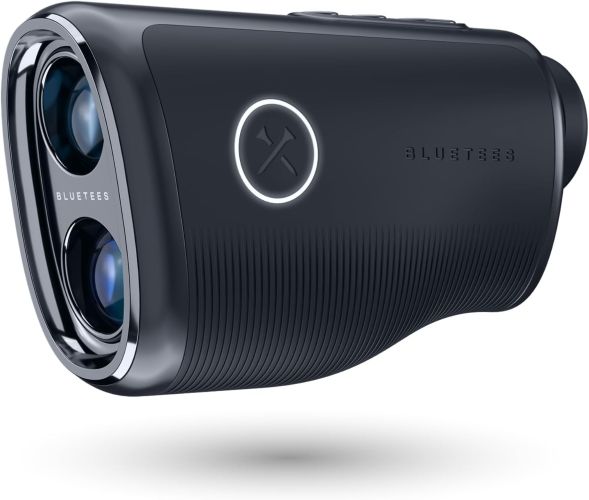
The Blue Tees Golf Captain Pro takes the traditional laser rangefinder concept and adds GPS course information, slope-related data, club recommendations, shot tracking, and app connectivity.
But is all of that technology actually useful on the course?
In this Blue Tees Golf Captain Pro review, we’ll look at its features, benefits, limitations, real-world use cases, alternatives, and the type of golfer who should consider buying it.
Blue Tees Golf Captain Pro Review: Quick Verdict
The Blue Tees Golf Captain Pro is a feature-rich golf rangefinder designed for golfers who want both laser distance measurement and GPS course information in one device.
According to the supplied specifications, it offers:
Up to 1200-yard laser range
7X magnification
OLED display
Flag Lock with vibration
GPS front, center, and back distances
Slope, elevation, wind, temperature, and humidity-related information
Built-in club recommendations
Laser shot tracking
Post-round performance insights
Bluetooth connectivity
Access to 42,000+ courses through the Blue Tees GAME app
Magnetic cart mount
IP67 protection
USB-C rechargeable battery
Our quick take
Best for: Golfers who want laser accuracy, GPS information, and performance tracking in one device.
Potential downside: Casual golfers who only need basic flag distances may not use enough of the advanced features to justify choosing a more feature-rich rangefinder.
Overall: The Captain Pro is an interesting option for golfers who enjoy technology and want more information than a traditional laser rangefinder provides.
The Blue Tees Golf Captain Pro is a hybrid golf rangefinder that combines laser distance measurement with GPS technology.
A traditional laser rangefinder is primarily designed to tell you the distance to a specific target.
The Captain Pro goes further by combining that laser measurement with GPS information about the golf hole.
For example, you can use GPS information to understand the front, center, and back of the green, then use the laser to target the flag or another specific object.
That combination can be useful when you’re making a complete shot decision rather than simply looking for one distance.
Blue Tees Golf Captain Pro Features
1. 1200-Yard Laser Range
The Captain Pro is specified with a 1200-yard laser range and 7X magnification.
For most golf situations, that provides plenty of distance for identifying targets around the course.
However, maximum range isn’t necessarily the most important factor when choosing a golf rangefinder.
What matters more is how quickly you can identify your target and get a useful distance when you’re ready to hit.
The Captain Pro is designed around that idea, with features such as Flag Lock and vibration feedback.
2. Flag Lock With Vibration
One of the most useful features on a golf laser rangefinder is the ability to lock onto the flag.
The Captain Pro includes Flag Lock technology with vibration feedback.
This is designed to make it easier to identify the flag when other objects are nearby.
For example, if trees or other objects are behind the green, it can sometimes be difficult to know exactly what the rangefinder has detected.
The vibration feedback provides an additional confirmation when the device locks onto the target.
For golfers who want quick yardages without repeatedly checking the display, this can be a useful feature.
3. GPS Front, Center and Back Distances
This is one of the features that makes the Captain Pro different from a basic laser rangefinder.
The device provides GPS information for the front, center, and back of the green.
Why does that matter?
Imagine the pin is 145 yards away.
That number tells you the distance to the flag, but it doesn’t tell the entire story.
If the front of the green is 132 yards and the back is 158 yards, you now have a better idea of the landing area.
That information can help you decide whether to attack the pin or play a safer shot toward the middle of the green.
For golfers who are trying to improve course management, this broader information can be more useful than a single number.
4. Slope, Elevation, Wind and Temperature Information
The supplied specifications describe the Captain Pro’s True Distance technology, which can account for factors including:
Slope
Elevation
Wind
Temperature
Humidity
The idea is to give golfers more information when deciding how a shot should play.
For example, a 150-yard uphill shot may require a different approach from a flat 150-yard shot.
Environmental conditions can also influence ball flight.
However, this information should be treated as a guide rather than a guarantee.
Your actual carry distance, ball flight, strike quality, wind changes, and playing conditions still matter.
5. Built-In Club Recommendations
Another interesting feature is the built-in club recommendation system.
Instead of simply showing a yardage, the Captain Pro can provide an on-screen club suggestion.
This could be particularly helpful for golfers who know their approximate club distances but sometimes hesitate when choosing between two clubs.
For example, you may know that you normally hit your 8-iron around a certain distance, but conditions can make the decision less obvious.
A club recommendation can provide another data point to consider.
That said, you should always use your own carry distances and experience as the final guide.
A rangefinder can provide information, but it cannot know exactly how well you’ll strike the next shot.
6. Laser Shot Tracking
The Captain Pro also brings performance tracking into the rangefinder.
Its laser shot tracking feature is designed to record shot distances and provide useful information through the connected app.
This could become valuable over time.
Instead of relying on memory, you can use recorded information to understand how far you actually hit your clubs.
For example, you may discover that:
Your 7-iron carry distance is different from what you assumed.
Your long irons have a larger distance gap than expected.
Some clubs are much more consistent than others.
Certain approach shots regularly finish short of the target.
Those insights can help you make better practice decisions.
7. Post-Round Performance Insights
The Captain Pro isn’t only designed for use during the round.
Its connected features can also help you review your performance afterward.
Looking at your shot information can help you identify patterns in your game.
Instead of simply asking, “Why did I shoot poorly today?” you can start asking more useful questions.
Which clubs caused the most problems?
Where are you consistently losing distance?
Are your approach shots finishing short?
Are you making good decisions around the course?
The more consistently you review your data, the more useful this feature can become.
8. Bluetooth Find-My-Rangefinder Feature
Losing a rangefinder is frustrating.
It can happen when you’re switching between a golf cart and your bag, leaving the device near a practice area, or simply forgetting where you put it.
The Captain Pro includes a Find My Rangefinder feature using Bluetooth connectivity through the app.
It’s not necessarily the feature that will convince someone to buy the device, but it is a practical addition.
For golfers who tend to misplace small accessories, it could prove surprisingly useful.
9. OLED Display
The Captain Pro uses an OLED display designed to provide clear information in different lighting conditions.
The display also includes adjustable brightness.
This matters because golf courses can have dramatically different lighting conditions throughout the day.
A bright display can help when you’re playing in strong sunlight, while brightness adjustment can make the screen more comfortable when conditions become darker.
10. Magnetic Cart Mount
The Captain Pro has a built-in magnetic cart mount.
This allows the rangefinder to be placed on a compatible golf cart for quick access.
Instead of constantly putting the device back inside your golf bag, you can keep it within reach.
For golfers who use a cart regularly, this is a small convenience that can make the device easier to use throughout the round.
11. IP67 Protection
The Captain Pro is specified with an IP67 rating.
This provides protection against dust and water exposure.
That’s useful because golf is an outdoor sport, and weather can change quickly.
A little rain shouldn’t necessarily mean the rangefinder has to be packed away immediately.
However, an IP rating shouldn’t be interpreted as an invitation to deliberately expose electronic equipment to unnecessary water.
As with any electronic device, reasonable care is still recommended.
Blue Tees Golf Captain Pro Specifications
Feature
Blue Tees Golf Captain Pro
Laser Range
Up to 1200 yards
Magnification
7X
Display
OLED
GPS
Front, center and back of green
Flag Lock
Yes
Vibration Feedback
Yes
Slope Technology
Yes
Club Recommendations
Yes
Shot Tracking
Yes
Performance Insights
Yes
Bluetooth
Yes
Course Database
42,000+ courses, according to supplied specifications
Charging
USB-C
Water/Dust Protection
IP67
Cart Mount
Built-in magnetic mount
Blue Tees Golf Captain Pro Pros and Cons
Pros
Laser and GPS functions in one device
Up to 1200-yard laser range
7X magnification
Flag Lock with vibration
Front, center, and back GPS distances
Slope-related information
Built-in club recommendations
Shot tracking
Post-round performance insights
OLED display
USB-C charging
Magnetic cart mount
IP67 protection
Find-My-Rangefinder feature
Cons
May have more features than casual golfers need
Connected features require app use
Club recommendations should be treated as guidance
More features can mean a learning curve
A basic laser rangefinder may be better for golfers who want simplicity
Current pricing should be compared with competing devices
Who Is the Blue Tees Captain Pro Best For?
Golfers Who Want Laser and GPS Together
This is probably the biggest reason to consider the Captain Pro.
Instead of carrying separate tools for GPS information and laser measurements, the Captain Pro combines both approaches.
If you like having more information before making a shot, this setup makes sense.
Golfers Who Enjoy Performance Data
If you’re the type of golfer who enjoys analyzing your rounds, the shot-tracking features may be especially appealing.
The device can turn ordinary rangefinder measurements into information you can use after the round.
Golfers Who Play Different Courses
GPS functionality becomes particularly useful when you’re playing a course you’re unfamiliar with.
You may not know where the front of the green starts, how much room is behind the flag, or exactly how a hole is laid out.
Having course information available can provide additional context.
Golfers Trying to Improve Course Management
Not every improvement comes from hitting the ball farther.
Sometimes better golf comes from making smarter decisions.
Knowing the front and back of the green, understanding the distance to the target, and considering the conditions can help you make more informed choices.
Who Should Consider a Simpler Rangefinder?
More features don’t automatically mean a better product for everyone.
If you only want to point a device at the flag and get a distance, you may not need GPS, shot tracking, club recommendations, or app connectivity.
A simpler laser rangefinder could be easier to use and potentially cost less.
The key question is simple:
Will you actually use the additional features?
If the answer is yes, the Captain Pro becomes more interesting.
If the answer is no, a basic rangefinder may make more sense.
Blue Tees Captain Pro vs. Basic Golf Rangefinder
Feature
Captain Pro
Basic Laser Rangefinder
Laser Distance
Yes
Usually
GPS
Yes
Usually no
Front/Center/Back
Yes
No
Flag Lock
Yes
Depends on model
Slope
Yes
Depends on model
Club Recommendations
Yes
Usually no
Shot Tracking
Yes
Usually no
App Connectivity
Yes
Usually no
Performance Insights
Yes
Usually no
Magnetic Mount
Yes
Depends on model
Simplicity
Moderate
Usually higher
The Captain Pro clearly targets golfers who want a more connected experience.
A basic laser rangefinder targets golfers who prefer simplicity.
Neither approach is automatically better.
It depends on what you want from your equipment.
Blue Tees Captain Pro: Real-World Use Cases
Approach Shots
Imagine you’re 150 yards from the green.
Instead of relying only on the flag distance, you can consider the front, center, and back of the green before deciding on your shot.
Then the laser can help you target the flag.
That’s a more complete picture of the hole.
Blind or Difficult Pins
Sometimes the flag is hard to see.
GPS information can still give you useful information about the green, while the laser can be used when a suitable target becomes visible.
This combination can be especially useful on unfamiliar courses.
Playing an Unfamiliar Golf Course
When you know a course well, you already have a mental picture of many holes.
On a new course, you don’t.
GPS information can help provide additional context before you choose your target.
Reviewing Your Round
The performance features can be useful after the round as well.
Instead of forgetting what happened on the 7th hole, you can use recorded information to identify patterns.
That can make your next practice session more focused.
Things to Consider Before Buying the Captain Pro
1. Do You Need GPS?
If you already use a golf GPS watch or smartphone app, think about whether having GPS built into the rangefinder adds meaningful value.
If you don’t currently have GPS, the combination could be more useful.
2. Will You Use Shot Tracking?
Shot tracking sounds appealing, but its value depends on whether you actually review the information.
If you’re interested in improving your game through data, it’s potentially useful.
If you simply want quick yardages, it may not matter much.
3. Do You Prefer Simple or Feature-Rich Equipment?
The Captain Pro is clearly designed for golfers who want multiple functions.
If you prefer equipment with minimal buttons and features, you may find a simpler rangefinder more comfortable.
4. Check the Current Price
Prices can change, and promotions may come and go.
Before purchasing, compare the current price of the Captain Pro with other laser rangefinders and GPS-enabled golf devices.
[Check Current Price & Features]
How to Get More Value From a Golf Rangefinder
A rangefinder is only as useful as the decisions you make with its information.
Here are a few ways to get more value from it:
Learn your average carry distances.
Create a distance chart for your clubs.
Use GPS to understand the entire green.
Use the laser for specific targets.
Consider slope and environmental information when appropriate.
Avoid choosing a club based only on maximum distance.
Review shot data after your rounds.
Look for patterns instead of focusing on one bad shot.
Use the information to improve course management.
The goal isn’t to make every shot perfect.
The goal is to make better-informed decisions.
Frequently Asked Questions
Is the Blue Tees Golf Captain Pro a GPS or laser rangefinder?
It’s designed as a combination of both. The Captain Pro combines laser distance measurement with GPS information, including front, center, and back-of-green distances.
How far can the Blue Tees Captain Pro measure?
The supplied specifications list a laser range of up to 1200 yards, along with 7X magnification.
Does the Blue Tees Captain Pro have slope?
Yes. The supplied specifications describe True Distance technology with slope functionality that can be toggled on or off.
Does the Captain Pro provide club recommendations?
Yes. The device is designed to provide club recommendations directly through its display.
However, golfers should use their own carry distances and experience when making the final club selection.
Can the Blue Tees Captain Pro track shots?
Yes. The Captain Pro supports laser shot tracking and post-round performance insights through its connected features.
Is the Blue Tees Captain Pro waterproof?
The supplied specifications list an IP67 rating, which provides protection against dust and water exposure.
As with other electronic devices, unnecessary prolonged exposure to water should still be avoided.
Is the Captain Pro good for beginners?
It can be.
Beginners may appreciate having GPS distances, laser targeting, and club recommendations in one device.
However, a golfer who prefers a simple point-and-measure rangefinder may prefer a less feature-rich option.
Final Verdict: Is the Blue Tees Golf Captain Pro Worth It?
The Blue Tees Golf Captain Pro is not simply trying to be another laser rangefinder.
Its main appeal is the combination of laser distance measurement, GPS course information, slope-related data, club recommendations, shot tracking, and performance insights.
That makes it particularly interesting for golfers who enjoy technology and want more information during and after their rounds.
The 1200-yard laser range, 7X magnification, Flag Lock, vibration feedback, OLED display, magnetic cart mount, USB-C charging, and IP67 protection add to the overall feature set.
But there’s an important distinction to remember.
More features don’t automatically mean better value.
If you only need a quick distance to the flag, a simpler rangefinder may be all you need.
If you want one device that combines laser targeting, GPS course awareness, and performance tracking, the Captain Pro is much more compelling.
Our recommendation
The Blue Tees Golf Captain Pro is worth considering for golfers who:
Want laser and GPS in one device
Like tracking their golf performance
Play multiple courses
Want front, center, and back green information
Appreciate club-selection assistance
Prefer feature-rich golf technology
If those features match how you play, it’s worth checking the current price and comparing it with similar golf rangefinders before making your decision.