

Businesses constantly seek ways to innovate faster, adapt to changing markets, and reduce operational costs. One of the most transformative trends shaping this effort is the rise of low-code and no-code platforms. These development tools promise to democratize software creation, allowing users with minimal or no programming knowledge to build robust applications. As we move through 2025, the question remains: Low-code vs. no-code — which is better for your business?
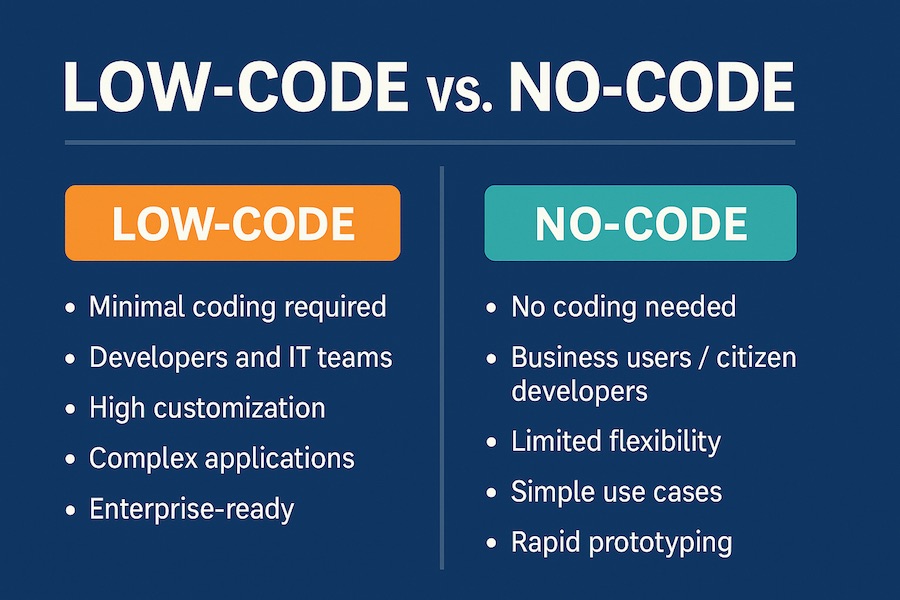
Low-Code vs No-Code Platforms
This article will explore both types of platforms, compare their benefits and limitations, examine current trends, and help you determine the right choice for your organization’s needs in 2025.
What Are Low-Code and No-Code Platforms?
Before diving into a comparison, it’s essential to understand what each term means.
Low-Code Platforms
Low-code development platforms (LCDPs) provide a graphical interface with drag-and-drop tools but still require some level of coding to customize complex workflows or integrate with enterprise systems. They are typically used by developers and IT professionals to accelerate application development.
Must Read : How to check if the Content is Plagiarized
Key features:
- Visual development environment
- Pre-built components and templates
- Integration support with existing systems
- Extensibility via custom code (JavaScript, Python, etc.)
No-Code Platforms
No-code development platforms (NCDPs) aim to completely eliminate the need for traditional coding. Designed for business users or “citizen developers,” they enable users to create applications through visual interfaces without writing a single line of code.
Key features:
- Fully drag-and-drop UI
- Workflow automation tools
- Pre-configured integrations
- Templates for common business needs
The Market Landscape in 2025
The market for both low-code and no-code platforms has grown significantly over the past few years. According to Gartner, by 2025, 70% of new applications developed by enterprises will use low-code or no-code technologies, up from less than 25% in 2020.
Several major players dominate this space in 2025:
- Low-Code: OutSystems, Mendix, Microsoft Power Apps, Appian
- No-Code: Airtable, Bubble, Webflow, Zoho Creator
Enterprises across sectors—from healthcare and finance to logistics and retail—are leveraging these tools to build internal dashboards, mobile apps, workflow automations, and customer-facing portals.
Must Read : The Rise of AI-Powered Development Tools
Benefits of Low-Code and No-Code Platforms
Both platforms offer game-changing advantages. Here’s how each can benefit your business:
Benefits of Low-Code Platforms
- Faster Development Cycles
Developers can rapidly prototype and deploy applications without starting from scratch. - Customization and Flexibility
Offers more control to experienced developers, allowing them to write code where needed. - Scalability
Supports integration with enterprise systems (ERP, CRM) and is more adaptable for large-scale deployments. - Collaboration Between IT and Business
Enables cross-functional teams to work together, with business users defining workflows and developers ensuring functionality. - Better Governance and Security
Low-code platforms typically offer robust governance tools, security controls, and compliance features.
Benefits of No-Code Platforms
- Empowering Non-Technical Users
Enables business analysts, marketers, and operations staff to build and iterate on apps without waiting for IT. - Cost-Efficiency
Reduces dependency on costly developer resources and shortens time-to-market. - Rapid Prototyping
Great for testing ideas or building MVPs (Minimum Viable Products) with minimal investment. - Encourages Innovation
Employees closer to the problem can design solutions themselves, fostering a culture of innovation. - Lower Learning Curve
No-code tools typically come with intuitive interfaces and comprehensive guides, making onboarding easier.
Must Read : Smodin Review – AI Writing Assistant
Key Differences: Low-Code vs. No-Code
| Feature | Low-Code | No-Code |
|---|---|---|
| User Base | Developers and IT teams | Business users / citizen developers |
| Coding Required | Minimal to moderate | None |
| Customization | High | Limited |
| Integration Complexity | Suitable for complex workflows | Best for simple use cases |
| Scalability | Enterprise-ready | Suitable for SMBs and prototyping |
| Governance & Security | Strong controls | Varies by platform |
| Time to Deploy | Moderate | Very fast |
Use Cases in 2025
Let’s look at how businesses in 2025 are utilizing each platform.
Common Low-Code Use Cases
- Custom CRM and ERP systems
- Field service mobile apps
- IoT dashboards and analytics tools
- HR onboarding portals
- Legacy system modernization
Common No-Code Use Cases
- Marketing automation workflows
- E-commerce websites
- Customer feedback forms
- Internal collaboration tools
- Inventory management for SMBs
Limitations to Consider
Despite their advantages, both platforms have limitations that businesses must consider:
Limitations of Low-Code
- Requires Technical Skills: Some coding is still needed for complex logic.
- Higher Costs: Licensing fees for enterprise-grade tools can be significant.
- Overhead for Simple Projects: May be overkill for basic apps.
Limitations of No-Code
- Limited Flexibility: Custom features or integrations may not be possible.
- Vendor Lock-in: Migrating away can be difficult once an app is built.
- Security and Compliance: Not all no-code platforms are built with enterprise-level security.
Which is Better for Your Business in 2025?
The answer depends on several factors, including the complexity of your project, your team’s technical skills, budget, and long-term goals.
Choose Low-Code If:
- You need to build complex applications that require integration with legacy systems.
- Your development team is small, and you want to accelerate delivery.
- You value flexibility and want to retain control over the app’s backend logic.
- Compliance, data security, and governance are critical to your organization.
Choose No-Code If:
- You want to empower business users to create their own solutions.
- Your use case is relatively simple (e.g., forms, internal dashboards).
- You need to test ideas quickly and iteratively.
- You are a startup or small business looking to build apps without hiring developers.
Hybrid Approach: The Future is Collaborative
Increasingly, businesses are adopting a hybrid approach, combining both platforms based on needs. For example:
- A no-code platform is used by the marketing team to build lead capture tools.
- A low-code platform is used by IT to integrate those tools with the CRM and analytics systems.
This collaborative model allows businesses to balance agility and control, making the most of both technologies.
Future Trends to Watch
As the market matures, several trends will shape the low-code/no-code landscape in 2025 and beyond:
1. AI-Powered Development
AI tools like natural language coding and automated testing are becoming embedded in both types of platforms, reducing development time further.
2. Enterprise-Grade No-Code Platforms
Vendors are adding advanced features to no-code platforms, making them viable for more complex applications.
3. Cross-Platform Deployment
Modern platforms support simultaneous deployment across web, mobile, and desktop with minimal configuration.
4. Open-Source Low-Code Tools
Community-driven platforms are gaining traction, offering flexibility without licensing costs.
5. Stronger Governance and Compliance Features
More platforms are offering GDPR, HIPAA, and SOC2 compliance out-of-the-box, making them safer for enterprise use.
Final Thoughts
In 2025, low-code and no-code platforms are not competitors but complementary tools. Each serves different business needs and user personas. The best choice depends on your organization’s structure, digital maturity, and specific project goals.
- For enterprises with complex needs and existing IT infrastructure, low-code platforms offer the flexibility, scalability, and control required for mission-critical applications.
- For teams looking to innovate quickly and empower non-technical users, no-code platforms offer unmatched speed and simplicity.
Ultimately, the most successful businesses will be those that adopt both strategically, creating a development ecosystem that’s agile, inclusive, and future-ready.