



Choosing the right chatbot can be surprisingly difficult. One tool might explain technical concepts clearly, while another might be better at writing, coding, summarizing documents, or answering everyday questions. All you need to know about AI Chatbot Arena is here.
Reading individual reviews only tells part of the story. What if you could compare two chatbots using the same prompt before deciding which response you prefer?

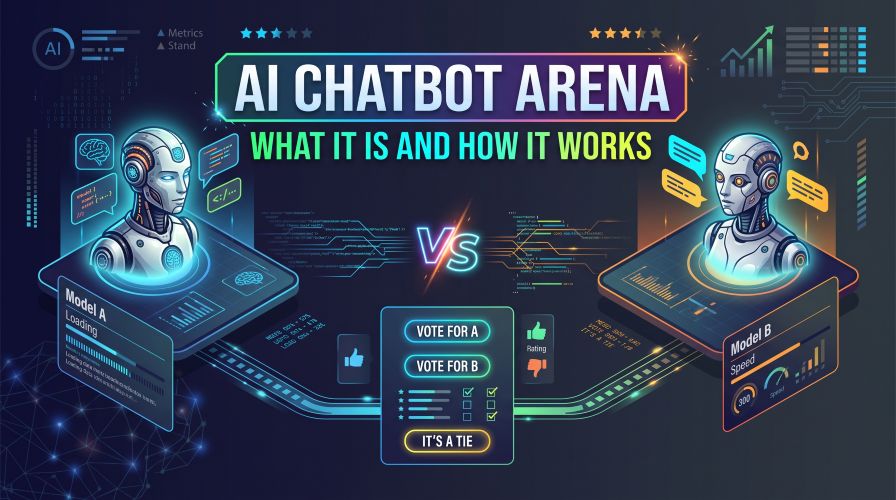
That is the idea behind AI Chatbot Arena, a platform built around side-by-side comparisons of language models and feedback from real users. Instead of relying entirely on marketing claims or isolated benchmark scores, visitors can evaluate competing responses and explore how different models perform.
Whether you are a student, developer, content professional, or simply curious about chatbot technology, understanding how the platform works can help you make more informed decisions.
In this guide, we will explain what AI Chatbot Arena is, how its comparison process works, how to interpret its leaderboard, and what to consider before choosing a chatbot for everyday use.
Quick Summary: AI Chatbot Arena at a Glance
- What it is: A platform for comparing language models through user evaluations and model rankings.
- How it works: Users submit prompts, compare responses, and provide feedback.
- Why it matters: It offers a practical way to explore differences between competing models.
- Who can benefit: Developers, researchers, students, businesses, and curious technology users.
- Is the leaderboard definitive? No. Rankings reflect a particular evaluation process and do not guarantee the best results for every task.
- Does a high ranking mean a chatbot is free? No. Ranking, access, usage limits, and subscription prices are separate considerations.
The main takeaway is simple: AI Chatbot Arena is a useful starting point for comparing model quality, but your own testing remains important.
What Is AI Chatbot Arena?
AI Chatbot Arena is an online platform associated with the research community behind Chatbot Arena, developed through work by LMSYS and collaborators. It enables people to compare responses from different language models and contributes user preferences to model evaluations.
Its best-known feature is the anonymous, side-by-side comparison experience, often called a chatbot battle.
A user enters a question or instruction, and two models generate responses. The responses are presented for evaluation, typically without initially revealing which models produced them. The user can then select the answer they prefer.
This approach makes the comparison more focused on the actual output rather than the model’s brand name.
For example, imagine you want a chatbot to explain a complicated spreadsheet formula. One response might be technically correct but difficult to understand, while the other might offer a clear explanation with a practical example.
Comparing the two helps you judge which response is more useful for your needs.
Why Was AI Chatbot Arena Created?
Language models are difficult to compare using a single score. A model that performs well on mathematical problems might not be the best choice for creative writing or explaining concepts to beginners.
Traditional benchmarks can help measure specific capabilities, but real-world usefulness also depends on factors such as clarity, instruction following, relevance, and response style.
A preference-based comparison offers another perspective. It asks people to judge actual outputs instead of depending exclusively on predefined test questions.
However, human preferences are not perfect measures of correctness. A confident-sounding answer may still contain mistakes, and different users may reasonably prefer different writing styles.
That is why Arena results are best understood alongside other forms of evaluation.
How Does AI Chatbot Arena Work?
The basic process is straightforward, even if the underlying evaluation system is more sophisticated.
Step 1: Submit a Prompt
A visitor enters a question, request, or task into the platform.
The prompt might ask for a beginner-friendly explanation of cloud computing, a Python code example, a product comparison framework, or a short story.
For a meaningful comparison, it helps to provide a clear instruction that reflects something you would genuinely ask a chatbot.
Step 2: Two Models Generate Responses
The platform sends the prompt to two participating models. Each model produces a response to the same request.
Using the same prompt creates a more useful comparison than testing one model with an easy question and another with a difficult one.
Nevertheless, the responses may vary in length, formatting, reasoning, or interpretation of the instruction.
Step 3: Compare the Answers
The two responses appear side by side or in a similar comparison layout.
At this stage, the goal is to judge the quality of the answers without being overly influenced by brand recognition.
Consider the following questions:
- Did the response answer the actual question?
- Was the explanation easy to follow?
- Were important details missing?
- Did the answer follow the requested format?
- Were the claims accurate and appropriately qualified?
- Would you use the response for your intended task?
These criteria are more useful than simply choosing the longer or more confident-sounding answer.
Step 4: Submit Your Preference
After reviewing the responses, the user selects the preferred answer or an available alternative, such as a tie or an option indicating that neither answer is satisfactory.
The exact controls may change as the platform evolves.
The preference can contribute to the evaluation data used to compare participating models.
Step 5: Explore Model Rankings
After completing a comparison, users may be able to reveal the model identities and explore the platform’s leaderboard or other model information.
The leaderboard summarizes performance according to the platform’s evaluation methodology.
Must Read : Is Notion Safe? Security, Privacy & Data Protection Guide
It is important to remember that a ranking represents a particular measurement system, not a universal verdict on which chatbot is best at everything.
Practical tip: If you are comparing chatbots for a specific job, repeat the test with several realistic prompts. One impressive response is not enough to establish consistent performance.
Understanding the AI Chatbot Arena Leaderboard
The AI model leaderboard is one of the platform’s most useful features for people researching competing language models.
Rather than comparing every model manually, visitors can review ranking information to identify models worth testing.
However, interpreting the results correctly matters just as much as finding the highest-ranked entry.
What Does an Arena Rating Mean?
Arena rankings have historically used preference-based rating methods, including Elo-style ratings and related statistical approaches. The exact methodology and presentation can change over time.
In an Elo-style system, a model’s rating is influenced by the outcomes of comparisons against other models. Performing well against stronger opponents can have a different statistical effect from winning against weaker opponents.
Modern leaderboard implementations may use additional statistical methods or display confidence intervals and other uncertainty information.
When examining a rating, consider the following:
- Relative performance: A rating describes performance within the relevant comparison system.
- Sample size: More evaluation data can provide a more stable estimate, although quantity alone does not eliminate bias.
- Uncertainty: Small rating differences may not represent a meaningful performance gap.
- Model version: Rankings can change when developers release updated models.
- Evaluation scope: A general preference ranking does not automatically measure coding accuracy, factual reliability, speed, or cost.
Always check the current leaderboard’s methodology and model details rather than assuming that every rating is directly comparable across different evaluation periods.
Does the Highest-Ranked Model Always Win?
No. A model near the top of the leaderboard may perform exceptionally well across the platform’s evaluation data, but that does not mean it will outperform every alternative on every task.
Suppose you need a chatbot to generate structured SQL queries. A model that performs well in broad conversational comparisons might not be the best fit for your database, schema, or preferred coding workflow.
Similarly, a model that produces excellent long-form explanations may be unnecessarily expensive for a simple classification task.
Use the leaderboard to create a shortlist. Then test the candidates against your own requirements.
Key Features and Benefits of AI Chatbot Arena
The platform’s main value comes from making model comparisons easier to understand.
1. Anonymous Response Comparisons
In blind comparisons, model identities are hidden initially so that brand familiarity has less influence on the user’s choice.
This does not eliminate every source of bias. Differences in response length, formatting, or writing style can still affect preferences.
Even so, evaluating the answers first can be a useful way to focus on the output itself.
2. Real-World Prompts
Users can compare responses to questions that reflect practical tasks rather than relying only on standardized benchmark questions.
This makes the experience relevant to people exploring chatbots for research, writing, coding, brainstorming, and everyday assistance.
However, user-submitted prompts vary widely in difficulty and quality, so the results should not be treated as a controlled scientific experiment in every individual comparison.
3. Community Preference Data
The collective preferences gathered through comparisons can help researchers evaluate how models are perceived in real interactions.
This is valuable because a technically capable model is not necessarily the most helpful one for a particular audience.
Community feedback still has limitations. Preferences can reflect personal taste, language differences, prompt selection, and other factors that do not always correlate with factual accuracy.
4. Leaderboard-Based Discovery
A leaderboard helps users discover models they may not have considered otherwise.
It can also provide a useful starting point for developers who want to identify candidates for more detailed testing.
Treat it as a research aid rather than a purchasing decision made on autopilot.
5. A Low-Commitment Starting Point
Exploring model comparisons can help you decide which tools deserve further investigation before spending money on subscriptions or API usage.
Availability, access requirements, and specific platform features can change, so check the current site for its latest options.
Pros and Cons of AI Chatbot Arena
No evaluation platform is perfect. Here is a balanced overview.
| Pros | Cons |
|---|---|
| Makes side-by-side comparisons easier | A preference does not prove factual correctness |
| Reduces initial brand-name influence in blind evaluations | Writing style can influence user choices |
| Offers a starting point for discovering models | Rankings may not reflect your specific workload |
| Uses feedback from actual users | User prompts and preferences can be uneven |
| Helps narrow a list of candidates | Does not replace testing for price, speed, or privacy |
| Can support model research without immediately committing to a paid plan | Features, access, and ranking methods may change |
The biggest benefit is accessibility: users can begin exploring differences without needing to understand every technical detail of language-model evaluation.
The biggest limitation is generalization. A model’s overall ranking may not predict how well it performs on your particular task.
AI Chatbot Arena vs. Other Chatbot Comparison Methods
AI Chatbot Arena is not the only way to evaluate language models. Depending on your goals, other approaches may provide complementary information.
| Comparison method | Best for | Main limitation |
|---|---|---|
| AI Chatbot Arena | Comparing actual responses and exploring community rankings | Preferences do not establish correctness |
| Standardized benchmarks | Measuring specific capabilities under defined conditions | Test results may not reflect everyday use |
| Direct testing in chatbot applications | Checking usability and performance on your own tasks | Requires time and consistent test prompts |
| Independent technical evaluations | Reviewing documented methodology and measured results | Findings may not match your requirements |
| Developer API testing | Evaluating cost, latency, reliability, and integration | Requires technical setup and usage monitoring |
AI Chatbot Arena vs. Standard Benchmarks
A benchmark typically evaluates models against a defined set of questions or tasks, often using a predetermined scoring method.
Arena-style comparisons focus more directly on human preferences between generated responses.
Both approaches have value. Benchmarks can help answer narrow performance questions, while preference comparisons can reveal differences in usefulness and presentation.
Neither approach should be treated as a complete measure of quality.
AI Chatbot Arena vs. Testing Chatbots Yourself
Personal testing is particularly important when you already know what you need a chatbot to do.
For example, a small business might compare two tools using customer-support drafts, frequently asked questions, and product-description tasks. A developer might test code generation, debugging, and structured output.
The best approach is to use Arena to identify promising candidates and then evaluate those candidates with representative examples from your own workflow.
Must Read : AI Tools for Marketers: Best Tools to Work Smarter
What About Other Chatbot Leaderboards?
Other model-evaluation projects may use different benchmarks, expert reviews, automated tests, or task-specific scoring systems.
Before comparing results across platforms, check whether they evaluate the same model version, task category, and performance criteria.
A model’s position on one leaderboard should not be assumed to translate directly to its position on another.
Who Should Use AI Chatbot Arena?
The platform can be useful for several audiences, although the value depends on what each person wants to learn.
Students and Everyday Users
Students and casual users can compare explanations, summaries, and brainstorming responses.
For educational work, treat chatbot answers as starting points and verify important facts against reliable sources. Do not assume that a fluent explanation is automatically correct.
Developers and Programmers
Developers can compare how models explain errors, generate code, follow instructions, or suggest debugging strategies.
For coding tasks, test whether the output runs correctly and satisfies the relevant security and performance requirements.
A polished code snippet is not necessarily production-ready.
Bloggers and Content Professionals
Writers can examine differences in structure, readability, tone, and instruction following.
If you publish technology content, evaluate whether a tool helps you produce accurate, original, useful material. Check facts, verify product specifications, and add expertise that genuinely serves readers.
The goal should be better editorial work, not simply more text.
Businesses and Technical Teams
Teams can use model comparisons during early-stage research before selecting a provider for a support workflow, internal knowledge tool, or software product.
A full evaluation should also consider data handling, access controls, reliability, cost, integration requirements, and the consequences of incorrect answers.
How to Compare Chatbots Effectively: A Practical Checklist
A structured testing process is more useful than picking a favorite based on one memorable response.
Use the following approach to evaluate candidates consistently.
Step 1: Define the job.
Choose one specific use case, such as summarizing a document, answering customer questions, explaining code, or extracting structured information.
Step 2: Prepare the same prompts.
Write five to ten realistic prompts that reflect common tasks. Keep the instructions consistent across the models you test.
Step 3: Establish evaluation criteria.
Score each response on factors such as accuracy, relevance, clarity, instruction following, and completeness.
Step 4: Verify important claims.
Check factual statements against authoritative sources. For code, run appropriate tests. For calculations, verify the results independently.
Step 5: Test consistency.
Try multiple examples instead of relying on a single comparison. Include straightforward tasks and more challenging cases.
Step 6: Compare practical costs.
If you plan to use a paid chatbot or developer API, examine subscription terms, usage limits, API pricing, and any additional costs relevant to your workload.
Step 7: Review privacy and security.
Before submitting sensitive information, check the provider’s data-use policies, retention settings, and available privacy controls.
This last step is especially important for business documents, customer records, confidential code, and personal information.
Choosing a Chatbot After Using Arena
A leaderboard can help you find candidates, but the right final choice depends on the trade-offs that matter to you.
Before subscribing to a tool or integrating it into a workflow, consider these factors.
Accuracy and Reliability
Choose a model that performs consistently on the tasks you actually need. For important decisions, build in human review and independent verification.
Features and Integrations
Check whether the product supports the capabilities you require, such as file uploads, coding tools, document analysis, collaboration features, or connections to existing software.
Do not pay for features you are unlikely to use.
Pricing and Usage Limits
Compare the complete cost, not just the advertised starting price.
For subscriptions, check message limits and included features. For APIs, consider input and output usage, model selection, and any additional infrastructure expenses.
Speed and Ease of Use
A slightly stronger answer may not be worth the trade-off if the tool is too slow or difficult for your daily workflow.
Test the actual interface or integration you plan to use, rather than assuming that a leaderboard measures user experience.
Privacy and Data Handling
Review whether prompts are stored, how information may be used, what retention options exist, and whether the product meets your organization’s requirements.
Avoid submitting confidential information until you understand the relevant policies and settings.
Must Read : Open Source Notion Alternatives: 10 Best Free Tools (2026)
Common Mistakes to Avoid When Using AI Chatbot Arena
Even a useful comparison platform can lead to poor decisions if the results are misunderstood.
Choosing a Tool Based Only on Rank
A high position is a useful signal, not proof of suitability. Test the model against your real tasks.
Assuming a Preferred Answer Is Correct
Human preference measures what people choose, not necessarily what is true. Verify important details independently.
Ignoring Model Versions
Providers regularly update their models. Make sure the model you test is the same version, or an equivalent version, that you intend to use.
Overlooking Price and Privacy
A model can perform well in comparisons while being unsuitable for your budget, security requirements, or integration needs.
Treating One Test as Conclusive
Individual prompts can produce unusual results. Use a consistent set of representative tasks and compare performance across multiple examples.
Frequently Asked Questions
1. What is AI Chatbot Arena used for?
AI Chatbot Arena is used to compare responses from different language models, collect user preferences, and explore model rankings. It can help users identify candidates for further testing.
2. Is AI Chatbot Arena free to use?
Access arrangements and available features can change. Check the current official platform for its latest access requirements and any applicable limitations.
3. How does AI Chatbot Arena rank models?
The platform has used preference-based comparisons and rating methods, including Elo-style approaches and related statistical techniques. Consult the current leaderboard documentation for the exact methodology and interpretation of its ratings.
4. Is the highest-ranked model always the best?
No. Overall rankings do not guarantee the best performance on every task. Coding, research, writing, and business workflows may require different strengths and evaluation criteria.
5. Are AI Chatbot Arena results reliable?
They provide useful evidence about comparative user preferences, but they are not a guarantee of factual accuracy or performance in every real-world situation. Consider sample sizes, evaluation methods, uncertainty, and task relevance.
6. Can developers use AI Chatbot Arena to choose a model?
Yes. Developers can use the comparisons and leaderboard to identify models for further testing. They should also evaluate API costs, latency, reliability, integration requirements, and security.
7. Is AI Chatbot Arena the same as a chatbot application?
No. An evaluation platform helps compare models, while a chatbot application provides an interface and features for interacting with a model. These serve related but different purposes.
8. Should I buy a chatbot subscription based on Arena rankings?
Not on rankings alone. Test the candidate with your own prompts, review its pricing and usage limits, and check its privacy policies before purchasing.
Final Verdict: Is AI Chatbot Arena Worth Exploring?
AI Chatbot Arena offers a practical way to explore differences between language models without relying entirely on product marketing or a single benchmark score.
Its side-by-side comparisons can help you identify models worth investigating, while its leaderboard provides a useful overview of performance under the platform’s evaluation approach.
Still, the most important question is not simply which model ranks highest. It is which tool reliably solves your problem, fits your budget, and meets your privacy and usability requirements.
For beginners, the best starting point is to compare a few responses to realistic prompts. For developers and businesses, the next step is a more structured evaluation that includes accuracy, cost, latency, and security.
Our recommendation: Use AI Chatbot Arena as a discovery and comparison resource, then test your shortlisted options before making a purchasing or integration decision.
If you decide to explore paid chatbot products afterward, compare current features and pricing carefully rather than assuming that the highest-ranked option is automatically the best investment.