


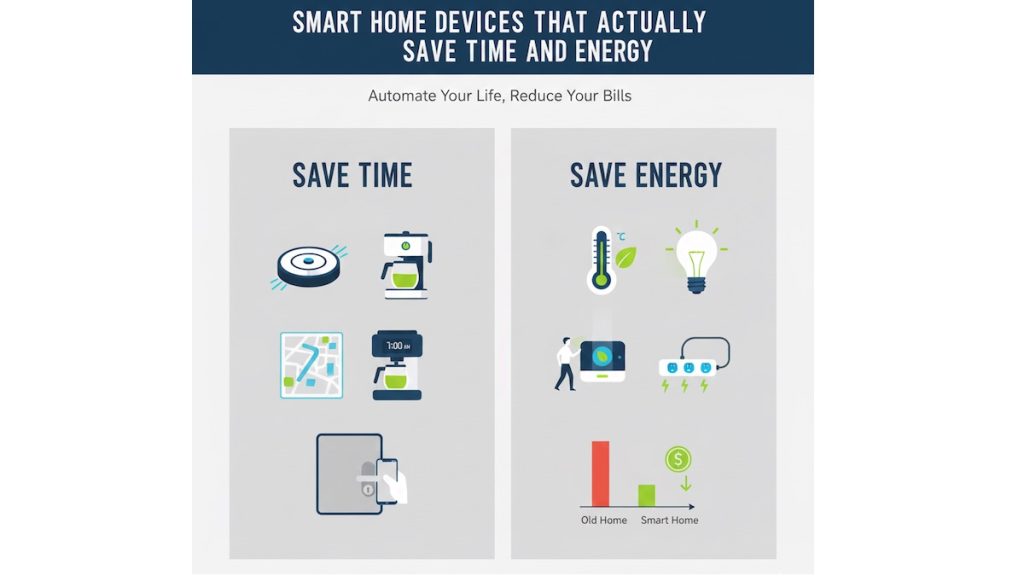
Smart home devices promise convenience, lower bills, and more free time.
But let’s be honest — many gadgets sound impressive and end up unused after a week.
So which smart home devices actually save time and energy instead of creating more work?
This guide cuts through the hype.
You’ll find proven, practical smart devices that solve real problems, reduce daily effort, and help control energy usage — without turning your home into a tech headache.


Whether you’re a beginner or already own a few smart gadgets, this article focuses on what works in real homes, not marketing slogans.
Quick Summary
If you’re short on time, start here:
- ✅ Smart thermostats reduce heating and cooling costs automatically
- ✅ Smart lighting systems cut energy waste and save daily effort
- ✅ Smart plugs eliminate phantom power drain
- ✅ Robot vacuums save hours of cleaning time
- ✅ Smart home hubs simplify control and automation
These devices offer the best balance of time savings, energy efficiency, and ease of use.
Why Smart Home Devices Matter in 2026
Rising energy costs and busy lifestyles make automation more than a luxury.
The right smart home setup helps you:
- Reduce unnecessary energy usage
- Automate repetitive daily tasks
- Monitor and control devices remotely
- Improve comfort without constant manual control
The key is choosing devices with real-world benefits, not gimmicks.
1. Smart Thermostats: The Biggest Energy Saver
Why Smart Thermostats Work
Heating and cooling account for a large portion of household energy use.
Smart thermostats optimize this automatically — something most people forget to do manually.
They learn your schedule, adjust temperatures intelligently, and prevent energy waste when no one is home.
Key Benefits
- Automatic temperature adjustments
- Remote control via smartphone
- Energy usage reports
- Geofencing (adjusts when you leave or return)
Real-World Example
Instead of running the AC all day, a smart thermostat reduces cooling when you’re out and restores comfort before you return — without touching a button.
Pros & Cons
| Pros | Cons |
|---|---|
| Significant energy savings | Higher upfront cost |
| Set-and-forget convenience | Needs compatible HVAC |
| Smart scheduling | Wi-Fi dependent |
Best for: Homeowners, renters with HVAC access, families with predictable schedules
2. Smart Lighting Systems: Small Change, Big Impact
How Smart Lighting Saves Time and Energy
Lights are often left on unintentionally. Smart lighting solves this quietly in the background.
You can automate lights based on schedules, motion, or ambient light — reducing waste without thinking about it.
Useful Features
- Motion sensors
- Scheduling and timers
- Dimming for energy efficiency
- Voice and app control
Time-Saving Scenarios
- Lights turn off automatically when rooms are empty
- Wake-up routines with gradual lighting
- Nighttime motion lights without switches
Pros & Cons
| Pros | Cons |
|---|---|
| Easy installation | Smart bulbs cost more |
| Reduces wasted electricity | Requires app setup |
| Custom automation | Wi-Fi or hub needed |
Best for: Apartments, families, energy-conscious users
3. Smart Plugs: The Hidden Energy-Saving Heroes
What Are Smart Plugs?
Smart plugs turn regular devices into smart ones.
They cut power when devices aren’t in use, stopping “phantom energy drain.”
Why This Matters
Many electronics draw power even when off — TVs, chargers, coffee machines.
Smart plugs help you:
- Monitor energy usage
- Set automatic shut-off schedules
- Control devices remotely
Best Use Cases
- Entertainment systems
- Kitchen appliances
- Office equipment
- Holiday lights
Pros & Cons
| Pros | Cons |
|---|---|
| Very affordable | Limited to on/off control |
| Easy setup | No advanced automation alone |
| Works with many devices | Needs Wi-Fi |
Best for: Beginners, renters, budget-conscious users
4. Robot Vacuums: Time-Saving Automation That Actually Works
Do Robot Vacuums Really Save Time?
Yes — when chosen correctly.
Modern robot vacuums handle daily dust and debris automatically, reducing how often you need to clean manually.
Smart Features That Matter
- Scheduled cleaning
- Room mapping
- Automatic docking and charging
- App control and reports
Real-Life Benefit
Set it to clean while you’re at work.
Come home to cleaner floors without lifting a finger.
Pros & Cons
| Pros | Cons |
|---|---|
| Saves hours weekly | Not a deep-clean replacement |
| Hands-free cleaning | Higher price for advanced models |
| Ideal for daily upkeep | Needs maintenance |
Best for: Busy professionals, pet owners, families
5. Smart Home Hubs: One Control Center
Why a Smart Home Hub Matters
As your smart home grows, managing multiple apps becomes frustrating.
A smart home hub connects devices into one ecosystem — enabling automation across brands.
What It Does
- Centralizes control
- Enables advanced routines
- Reduces app clutter
- Improves device compatibility
Example Routine
“Good Night” routine:
- Lights off
- Thermostat adjusted
- Smart plugs powered down
All triggered with one command.
Pros & Cons
| Pros | Cons |
|---|---|
| Simplifies control | Initial setup time |
| Scalable automation | Extra cost |
| Reduces complexity | Learning curve |
Best for: Multi-device users, tech enthusiasts
Comparison Table: Best Time & Energy Saving Devices
| Device Type | Time Saved | Energy Saved | Ease of Use |
|---|---|---|---|
| Smart Thermostat | Medium | High | Medium |
| Smart Lighting | Low | Medium | High |
| Smart Plugs | Low | Medium | Very High |
| Robot Vacuum | High | Low | High |
| Smart Hub | Medium | Indirect | Medium |
Buying Guide: How to Choose the Right Smart Home Devices
Before buying, consider:
1. Compatibility
- Works with your phone and Wi-Fi
- Supports existing devices
2. Ease of Use
- Simple app interface
- Reliable automation
3. Real Benefits
- Solves a daily problem
- Saves time or energy consistently
4. Scalability
- Can grow with your setup
- Supports future devices
Common Mistakes to Avoid
- Buying too many devices at once
- Ignoring compatibility
- Over-automating simple tasks
- Choosing cheap devices with poor app support
FAQs – Smart Home Devices & Energy Savings
1. Do smart home devices really save energy?
Yes, when used correctly. Devices like smart thermostats and lighting reduce unnecessary usage automatically.
2. Are smart devices expensive to maintain?
Most have minimal ongoing costs beyond electricity and internet access.
3. Can renters use smart home devices?
Absolutely. Smart plugs, bulbs, and robot vacuums are renter-friendly.
4. Do I need a smart home hub?
Not initially. A hub becomes useful as you add more devices.
5. Are smart devices safe to use?
Reputable brands follow strong security standards. Always update firmware regularly.
6. Will smart devices increase my electricity bill?
Typically no — most reduce overall energy usage.
Internal Linking Suggestions
- Best energy-efficient home gadgets
- Smart home setup for beginners
- How to reduce electricity bills with technology
- Wi-Fi devices for home automation
Final Verdict: Are Smart Home Devices Worth It?
Smart home devices do save time and energy — when chosen wisely.
Start small.
Focus on devices that solve real problems.
Avoid gimmicks.
If your goal is a calmer, more efficient home, the devices in this guide offer real value without complexity.
👉 Ready to upgrade smarter?
Check price, compare features, and learn more before choosing what fits your lifestyle.