


Have you ever bought a power bank that looked perfect on paper, but felt disappointing after a few days of use?
Maybe it charged your phone painfully slow.
Or maybe it charged fast—but died way too quickly.

You’re not alone.
With buzzwords like PD fast charging, Quick Charge, 20,000mAh, and 65W output everywhere, choosing the right power bank has become more confusing than it should be.
This guide breaks everything down in plain English so you can finally understand the real difference between charging speed vs capacity—and choose the right power bank for your needs.
Quick Summary for Busy Readers
- Charging speed decides how fast your device charges
- Capacity (mAh) decides how long the power bank lasts
- Fast charging without enough capacity = frequent recharging
- High capacity without fast charging = slow experience
- The best power bank balances both based on usage
What Is a Fast Power Bank?
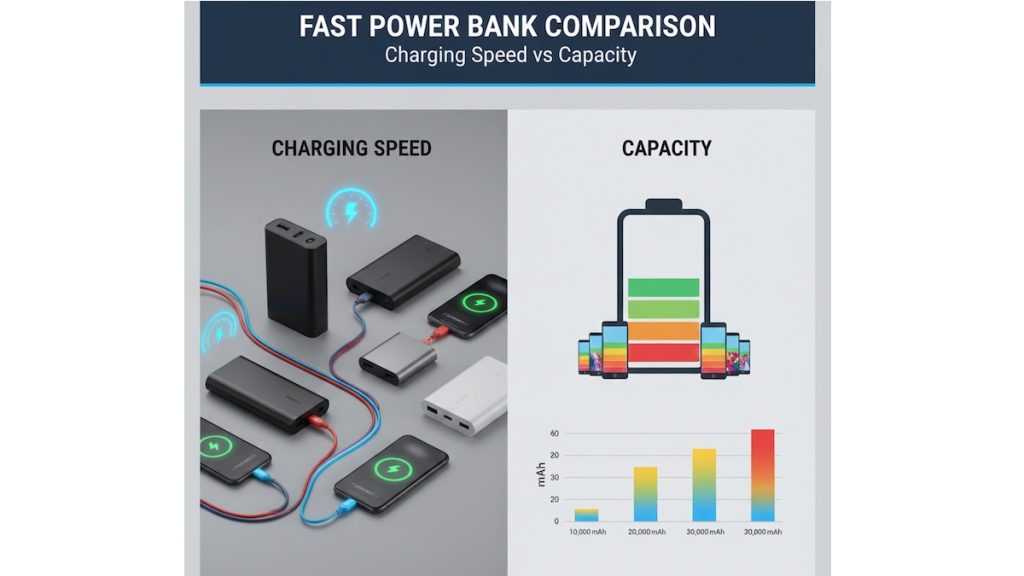
A fast power bank isn’t about size or price—it’s about power output.
Charging speed depends on:
- Output wattage (W)
- Supported fast-charging standards
- Cable and device compatibility
Common Fast-Charging Standards You’ll See
- USB Power Delivery (PD) – Best for phones, tablets, and laptops
- Qualcomm Quick Charge (QC) – Popular with Android devices
- PPS (Programmable Power Supply) – Smarter, cooler charging
A 10,000mAh power bank with 30W PD can charge your phone faster than a 30,000mAh power bank limited to 12W output.
Must Read : Best Type C Charger with Long Wire (Fast & Reliable)
Understanding Power Bank Capacity (mAh Explained Simply)
Capacity is measured in milliampere-hours (mAh).
What Capacity Means in Real Life
| Capacity | What You Can Expect |
|---|---|
| 5,000mAh | Emergency top-up |
| 10,000mAh | 1–2 phone charges |
| 20,000mAh | 3–4 phone charges |
| 30,000mAh+ | Multiple devices or long trips |
Keep in mind: due to energy loss, you usually get 70–80% usable power, not 100%.
Charging Speed vs Capacity: What’s the Real Difference?
This is where most buyers get stuck.
Charging Speed
- Measured in Watts (W)
- Determines how fast your device charges
- Critical for modern smartphones, tablets, and laptops
Capacity
- Measured in mAh
- Determines how long the power bank lasts
- Important for travel, emergencies, and multiple devices
Both matter—but not equally for everyone.
Comparison Table: Fast Charging vs High Capacity
| Feature | Fast Charging Power Bank | High-Capacity Power Bank |
|---|---|---|
| Main Focus | Speed | Longevity |
| Typical Output | 18W–65W+ | 12W–18W |
| Weight | Lighter | Heavier |
| Best For | Quick top-ups | Long usage |
| Recharge Time | Faster | Slower |
Why Fast Charging Matters More Today
Modern devices are designed to charge fast.
Real-World Example
- 18W charger → about 2 hours
- 30W charger → about 1 hour
- 65W charger → under 45 minutes
If your power bank doesn’t support fast charging:
- You waste time
- Devices heat up more
- Battery efficiency suffers
That’s why fast charging is no longer a luxury—it’s a necessity.
When Capacity Matters More Than Speed
Fast charging isn’t everything.
Choose higher capacity if you:
- Travel often
- Go camping or hiking
- Use multiple devices daily
- Experience power outages
Example use case:
A traveler charging a phone, earbuds, smartwatch, and camera will benefit more from 20,000mAh or higher, even if charging is slightly slower.
The Sweet Spot: Balanced Fast Power Banks
For most people, the best choice is a balanced power bank.
Ideal Specs for Most Users
- Capacity: 10,000–20,000mAh
- Output: At least 30W USB-C PD
- Ports: USB-C + USB-A
- Fast input recharge support
These models offer speed without unnecessary bulk.
Must Read : Best Budget Earbuds in 2026
Real-World Use Cases: Which One Should You Choose?
For Office & Daily Commute
- 10,000mAh
- 20–30W fast charging
- Slim and lightweight
For Travelers & Digital Nomads
- 20,000–30,000mAh
- 45–65W USB-C PD
- Laptop-compatible
For Students
- Affordable fast charging
- 10,000–20,000mAh
- Compact design
For Gamers & Power Users
- High wattage output
- Efficient heat control
- Short recharge time
Pros and Cons Breakdown
Fast Charging Power Banks
Pros
- Saves time
- Ideal for modern devices
- Less heat during charging
Cons
- Higher price
- Smaller capacity in some models
High-Capacity Power Banks
Pros
- Long-lasting power
- Great for multiple devices
- Ideal for emergencies
Cons
- Heavy and bulky
- Slow recharge
- Less pocket-friendly
Things to Consider Before Buying a Power Bank
1. Output Wattage
- Phones: 18–30W
- Tablets: 30–45W
- Laptops: 45–65W+
2. Input Charging Speed
A fast output means nothing if the power bank itself takes 10 hours to recharge.
3. Ports & Compatibility
USB-C is future-proof. Multiple ports mean shared power.
4. Safety & Build Quality
Look for overcharge protection, temperature control, and certified batteries.
Frequently Asked Questions (FAQs)
Is fast charging bad for battery health?
No. Modern fast charging is temperature-controlled and safe when supported by the device.
Is higher mAh always better?
Not necessarily. High capacity without fast charging can be frustrating.
Can power banks charge laptops?
Yes, but only models supporting USB-C PD (45W or higher).
Why does charging feel slower sometimes?
Cable quality, device limits, and power sharing affect speed.
Is wireless charging slower than wired?
Yes. Wireless charging is convenient but less efficient.
How long does a power bank last?
Most last 300–500 charge cycles before noticeable capacity loss.
Must Read : Why Is My Phone Screen Pressing Itself? Causes, Fixes, and Long-Term Solutions
Internal Linking Suggestions
- Best USB-C Power Banks for Travel
- Fast Charging Standards Explained
- How to Extend Smartphone Battery Life
- Power Bank Safety Tips
Final Verdict: Charging Speed or Capacity?
There’s no one-size-fits-all answer.
If you value time, prioritize fast charging.
If you value endurance, prioritize capacity.
If you want the best experience—balance both.
A well-balanced fast power bank:
- Saves time
- Lasts all day
- Works with modern devices
- Feels future-proof
👉 See full features of recommended fast power banks and choose what fits your lifestyle best.